Here's an uncomfortable statistic: the vast majority of business owners who try to sell their business never actually close a deal. Not because the business isn't good. Because they didn't start preparing until they were already trying to sell it.
Nobody runs a marathon with zero training, starting the morning of the race. But that's exactly how most owners approach the biggest financial transaction of their life. They wake up one day, decide they're "ready to sell," call a broker, and then spend the next year scrambling to fix problems that took a decade to create.
Selling a business isn't an event. It's a five-year project that happens to end with an event. This article walks through what that five-year runway looks like: the documentation, the financials, finding the right buyer, and the part almost nobody talks about, which is getting your head right before handing over the thing you've built your identity around.
Why Five Years, Not Five Months
The obvious question: why five years? Why not just clean things up the year before you sell?
Because buyers aren't just buying your business today. They're buying proof that it will still be a good business without you in it tomorrow. And proof takes time to build. You can't fake three years of clean financials in three months. You can't fake a stable customer base that isn't dependent on your personal relationships in three months. Buyers, and more importantly the banks financing those buyers, want a track record, not a promise.
Five years also happens to be roughly how long it takes to fix the kinds of problems that quietly kill deals: messy books, an over-reliance on the owner personally, a customer list where one client is 40% of revenue. None of that gets fixed overnight. It gets fixed with time, and time is exactly what a lot of owners run out of because they didn't start the clock early enough.
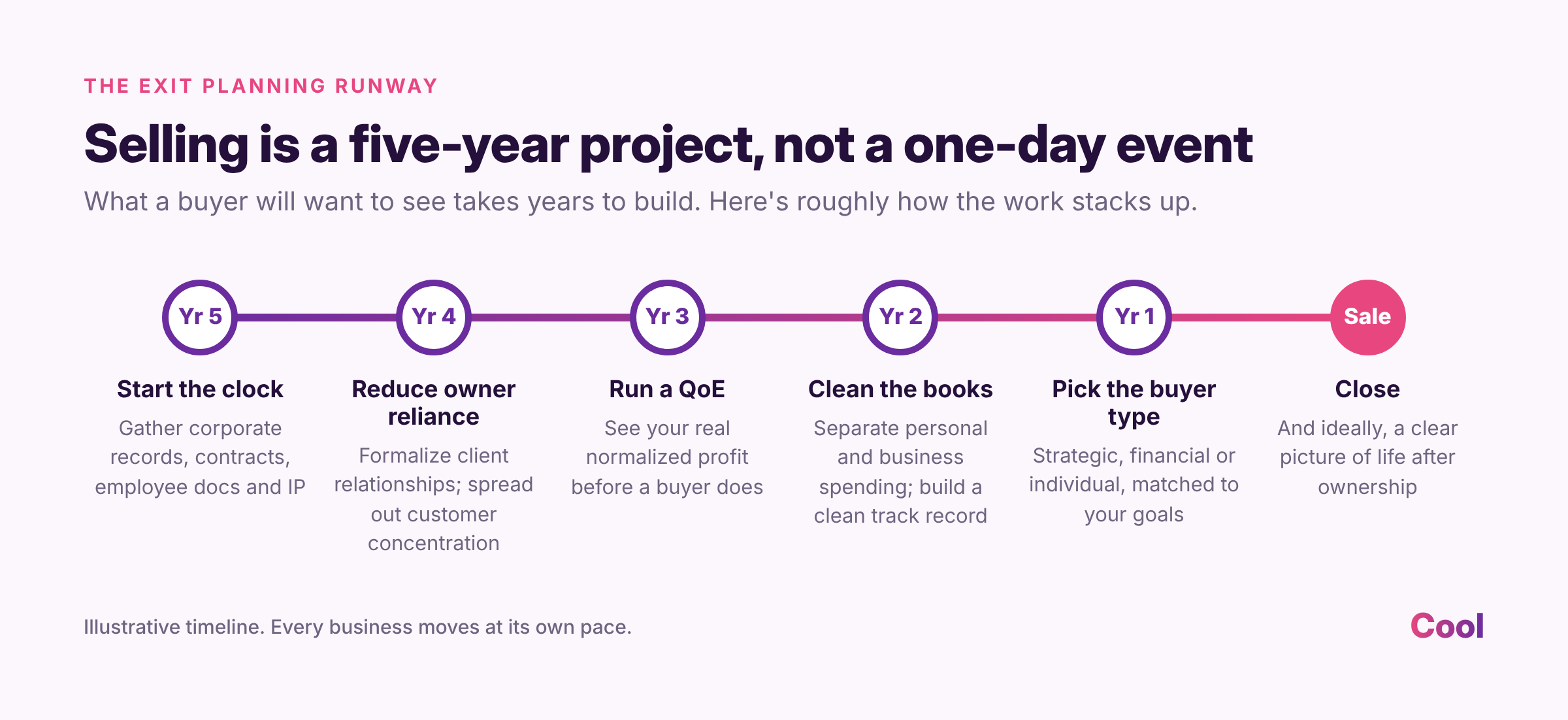
Think of it as four pillars, each of which takes years rather than months to get right.
Pillar 1: Get Your Documentation in Order
Documentation is the unglamorous part of exit planning, which is exactly why most owners avoid it, right up until a buyer's attorney asks for something that doesn't exist and the whole deal grinds to a halt.
Here's what buyers and their lawyers typically want to see:
Clean corporate records. Operating agreement, bylaws, minutes from major decisions, and anything showing the business has been run like a business, not a collection of decisions made over text message.
Every material contract. Leases, vendor agreements, customer contracts, anything with a signature on it.
Employee documentation. Offer letters, job descriptions, and anything showing the team isn't held together by verbal agreements and good vibes.
Intellectual property. Trademarks, proprietary processes, and anything that makes your business yours and not easily copied by whoever buys it, or worse, whoever doesn't.
Example: Tom's Handshake Deals
Picture a guy named Tom who owns a commercial cleaning company. Great business, growing fast, profitable for years. Tom finally decides to sell, finds a buyer, and everything is moving smoothly until the buyer's attorney asks for signed contracts with Tom's five biggest clients.
Tom doesn't have them. Some of those handshake deals go back a decade. No signatures, nothing in writing. Suddenly the buyer can't be sure that revenue transfers with the sale at all, because legally, nothing obligates those clients to stay. The deal doesn't die completely, but the price drops, hard, and closing gets delayed by months while Tom scrambles to formalize relationships he should have documented years earlier.
The lesson from Tom: this paperwork is far easier to collect and organize while there's time, instead of under deadline pressure with a buyer standing over your shoulder.
Pillar 2: Clean Up Your Financials
This is arguably the biggest lever on your actual sale price.
Here's something that surprises a lot of owners: the way you run your books for tax purposes and the way you'd want your books to look for a sale often work against each other. For years, your accountant has probably been helping you minimize taxable income, running personal expenses through the business, keeping things lean on paper. Smart tax strategy. Terrible sale strategy, because buyers pay a multiple of your profit. Every dollar hidden from the IRS for tax purposes is a dollar hidden from a buyer, at multiple times its value.
What a Quality of Earnings Analysis Does
A Quality of Earnings (QoE) analysis is a deep, buyer's-eye-view review of your financials that normalizes everything. It adds back one-time expenses, strips out personal spending that shouldn't be there, and shows what the business actually earns on a repeatable basis. Getting one done proactively, years before a sale, does two things: it shows you your real number before a buyer does, and it gives you time to fix what it finds.
Example: Sarah's $80,000 in Add-Backs
Sarah owns a marketing agency. For years, her business has covered her car lease, a chunk of her family's health insurance, and a handful of "business trips" that were really vacations with a client email sent from the resort. Totally normal small business behavior. Her accountant even encouraged some of it to reduce her tax bill.
When Sarah starts prepping to sell three years out, she runs a Quality of Earnings analysis and finds almost $80,000 a year in these kinds of add-backs. At a reasonable multiple, that's not just $80,000. It could be several hundred thousand dollars in additional sale price once a buyer applies that multiple to the real, normalized profit.

Sarah spends the next two years cleaning up her books and properly separating personal and business expenses. By the time she goes to market, her financials tell a much cleaner, and much more valuable, story.
Same business. Same actual cash flow. Wildly different outcome, just from knowing this three years earlier instead of finding out from a buyer's accountant.
Pillar 3: Find the Right Buyer, Not Just a Buyer
This pillar gets skipped constantly. There's a big difference between the right buyer and any buyer with a checkbook. Buyers generally fall into three groups:
Strategic buyers are often competitors or companies in adjacent industries. They might pay a premium because your business fills a specific gap for them.
Financial buyers, like private equity, are buying cash flow and usually want the owner to stay involved for a transition period.
Individual buyers are often looking to step into your shoes and run the business themselves.
Each of these wants something different, pays differently, and structures deals differently.
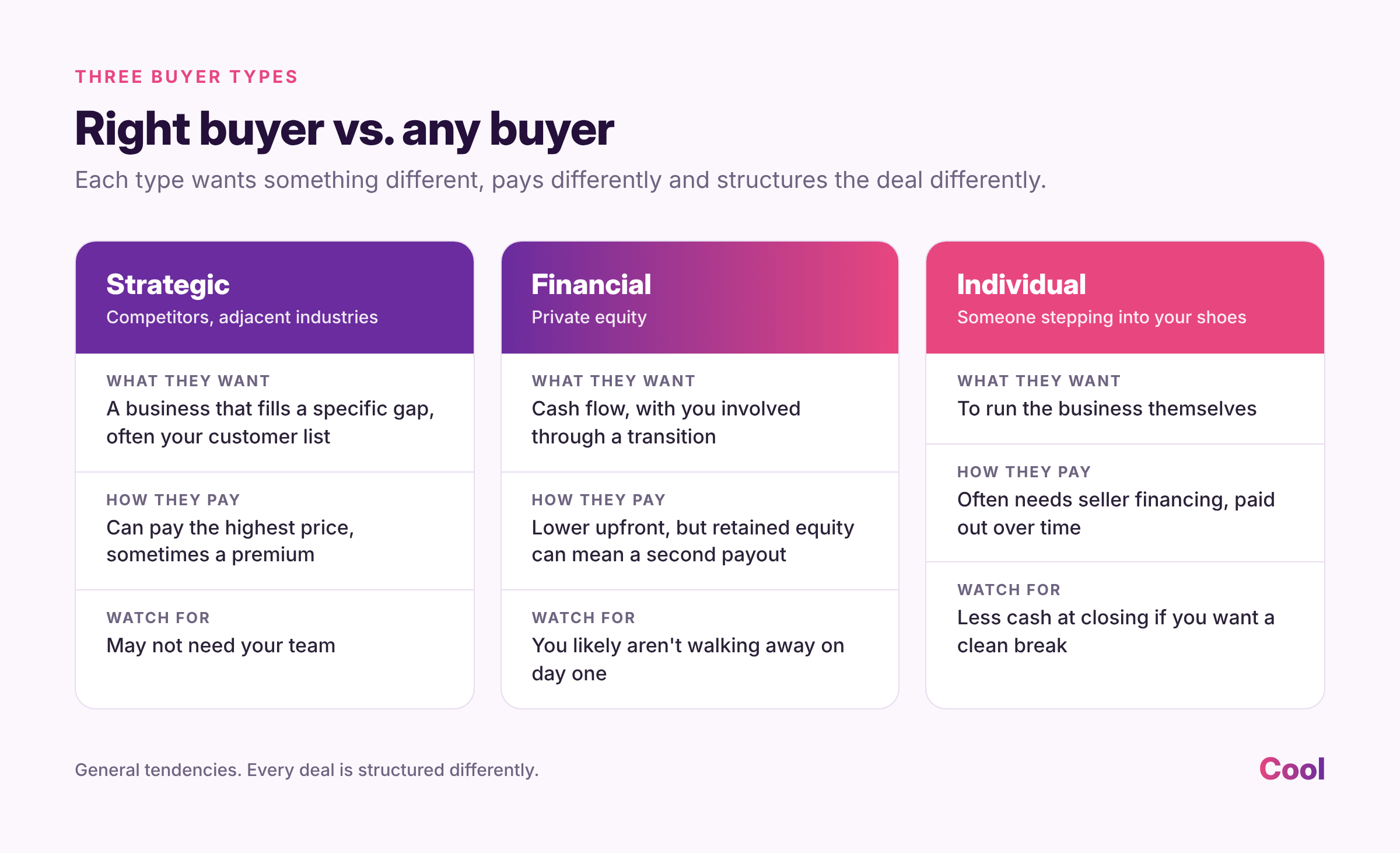
A strategic buyer might pay the highest price but wants your customer list and might not need your team. A financial buyer might offer a lower upfront number but structure a deal where you keep some equity and get a second payout down the road. An individual buyer might need seller financing, meaning you get paid out over time instead of in one lump sum at closing.
The mistake owners make is not figuring out which type of buyer fits their business, and their own goals, until a buyer shows up. An owner who knows five years out that they want a clean break with cash at closing can use that to shape who they even start conversations with. Chasing the wrong buyer type can waste a year of negotiations that were never going to end the way the owner wanted.
Pillar 4: Get Yourself Psychologically Ready
This is the pillar nobody puts in the spreadsheet: you, personally, getting ready to let go.
Here's what nobody warns owners about. You've spent years, maybe decades, being the person everyone calls when something goes wrong. Your identity, your daily rhythm, and probably a good chunk of your social life are wrapped up in this business. Then one day, if the sale goes well, all of that just… stops.
A lot of owners aren't prepared for how strange that feels, and it can sabotage a deal. Owners get cold feet, negotiate erratically, or quietly torpedo their own sale because some part of them isn't ready to say goodbye, even though they told everyone, including themselves, that they were.
The fix isn't complicated, but it takes time, which is exactly why it belongs in the five-year window and not the five-week window. It starts with picturing life on the other side. What does a Tuesday look like without the business? Who are you if you're not "the owner"?
Some owners answer that by building interests and relationships outside the business well before the sale. Some negotiate a consulting or transition role into the deal, specifically because going from a hundred hours a week to zero overnight sounds less like retirement and more like a personality crisis with a severance package.
Whatever the answer is, it's far better figured out before sitting across from a buyer than during the negotiation.
Bringing It Together
Five years out, you're not selling yet. You're building the version of your business, and honestly the version of yourself, that's actually ready to be sold:
Clean documentation so nothing stalls the deal.
Financials that tell the business's real story, not just its tax story.
A clear-eyed view of which buyer fits what you want.
An owner who is genuinely ready to let go, not just saying so.
Do this work early, and by the time you're sitting at the closing table, the biggest transaction of your life feels like a formality, not a scramble.
Where Cool Wealth Management Fits In
Clean books, a tax strategy that doesn't undercut your sale price, and a plan for the wealth on the other side of the closing table: that's exactly what we do. Your Business. Your Taxes. Your Wealth. All Under One Roof. If a sale is somewhere on your five-year horizon, reach out to start the conversation.
