How Much Is My Business Worth? And Do I Have Enough to Retire?
Most business owners can tell you their revenue down to the dollar. Ask the same person what they're actually worth — total, everything included — and you'll usually get a shrug, a guess, or the classic: "Well, the business is worth a lot, so... I'm probably fine?"
Probably fine is not a retirement plan.
This article tackles two questions that business owners tend to blur together. First, what is your business actually worth — not a Google-search answer, a real one? Second, and far more important: separate from the business, do you have enough, or are you on track to have enough, to retire?
Those are two different numbers. Treating them as the same number is exactly how successful owners end up working an extra decade they never planned on.
Key takeaways
Your business value is one asset on your balance sheet, not your retirement plan.
Your real retirement number is built by working backward from the income you want, divided by a safe withdrawal rate.
Reinvesting in a healthy business can out-earn the market — until it hits a ceiling.
Past roughly six figures of income, setting money aside outside the business makes sense for diversification alone.
Tax-advantaged accounts built for owners, like the SEP IRA and Solo 401(k), allow contributions up to $72,000 in 2026.
Insurance, estate documents, an exit strategy, and your post-business identity belong in the same plan.
How much is my business worth?
In one sentence: your business is generally worth some multiple of its profit. That multiple is how many times your annual earnings a buyer would reasonably pay. It's driven by:
Your industry — some sectors simply trade at higher multiples than others.
Your growth — a business growing steadily is worth more than one that's flat.
Your margins — more profit per dollar of revenue means more value.
Owner dependence — how much the whole operation relies on you personally. The more it runs without you, the more a buyer will pay.
The exact multiple varies wildly from one business to the next. That's exactly why "the business is worth a lot" is a feeling, not a number.
Why the sale shouldn't be your entire retirement plan
Many owners treat an eventual sale as their whole retirement plan. The math sounds fine in your head: "I'll sell for a few million, retire, done."
That plan depends on three enormous variables you don't control:
Will you find a buyer at all?
Will they pay what you think it's worth?
Will the timing line up with when you actually want to retire, instead of when the market happens to cooperate?
A business that's worth two million dollars on paper is worth exactly zero dollars toward your retirement until someone actually writes you a check for it.
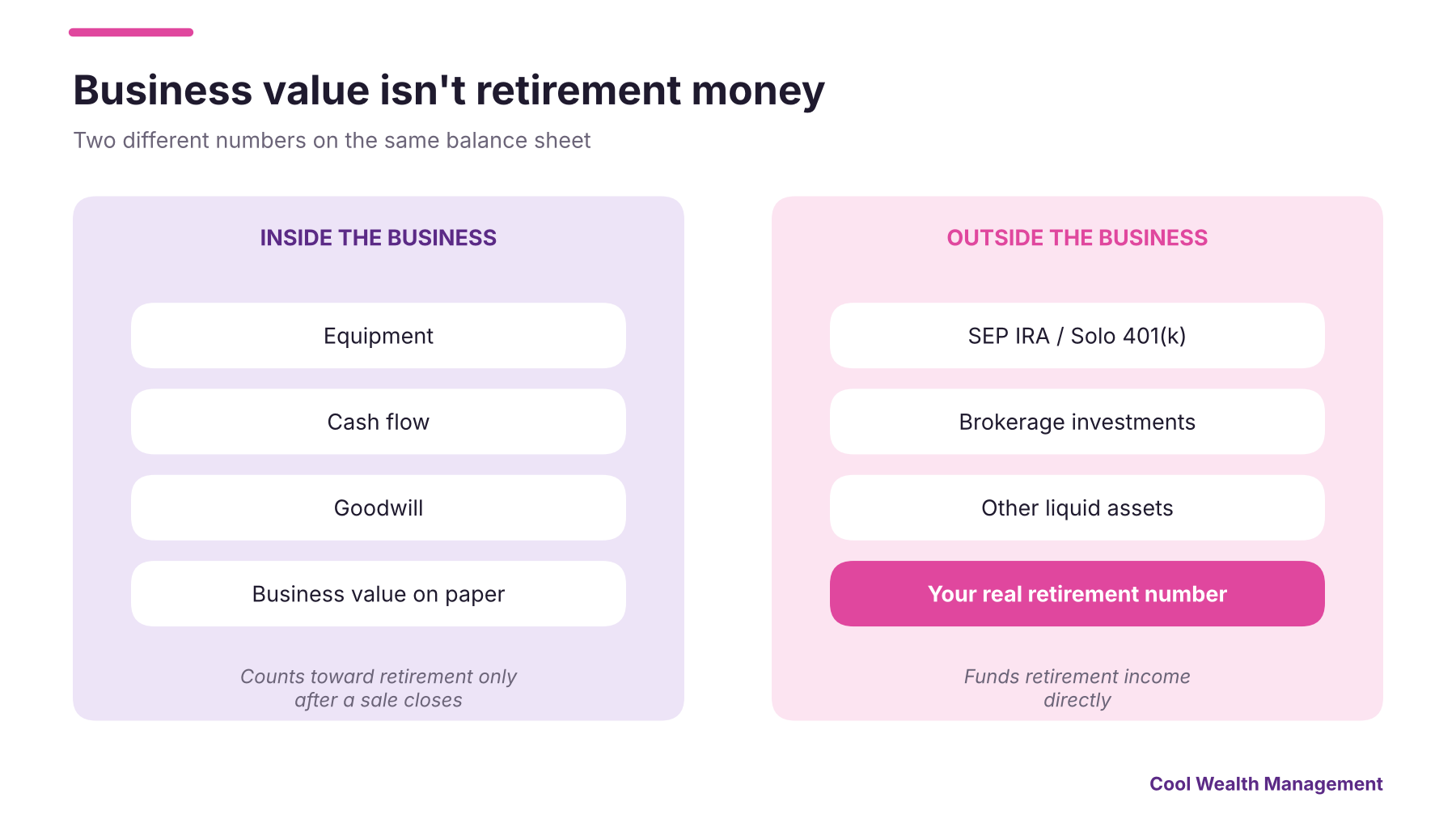
So the business value question matters. It just isn't the whole answer. It's one asset on a much bigger balance sheet — and that balance sheet is where the real retirement conversation happens.
How to calculate your real retirement number
Here's the number that actually matters: how much do you need built up, outside the business, to retire the way you actually want to live?
Working backward from the life you want
Most financial planning answers this question by working backward in three steps:
Start with your desired retirement income. Not necessarily your current income — what you'd actually need each year to live the life you want once you're not working.
Apply a safe withdrawal rate. This is a percentage you could reasonably pull from your investments each year without running out of money over a multi-decade retirement. A commonly used starting assumption is around 4%.
Divide your income by that rate. The result is your target for investable assets — your real retirement number.
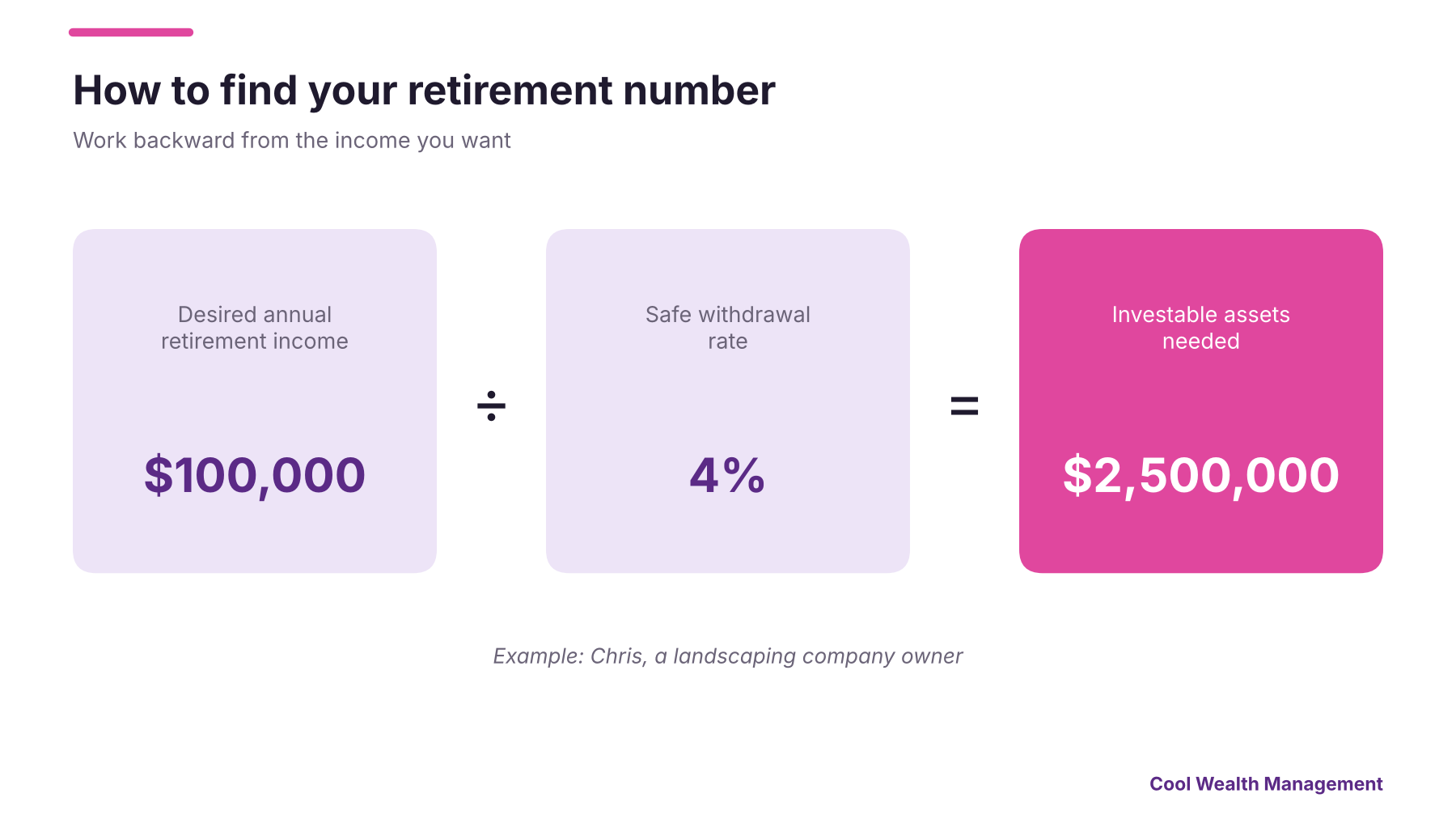
Example: Chris, a landscaping company owner
Meet Chris, who owns a landscaping company. Chris figures he'd want about $100,000 a year in retirement income to live comfortably.
Using a reasonable withdrawal rate assumption, Chris would want somewhere in the neighborhood of $2.5 million in investable assets. Not business value — actual liquid, invested assets that can support that income for the rest of his life.
Here's where it gets uncomfortable for a lot of owners. When Chris adds up his investment accounts outside the business, he's nowhere close.
Most of what Chris has built over the last fifteen years is sitting inside the business itself:
Equipment
Cash flow
Goodwill
None of that counts toward his $2.5 million number until the business is sold and the proceeds are invested elsewhere.
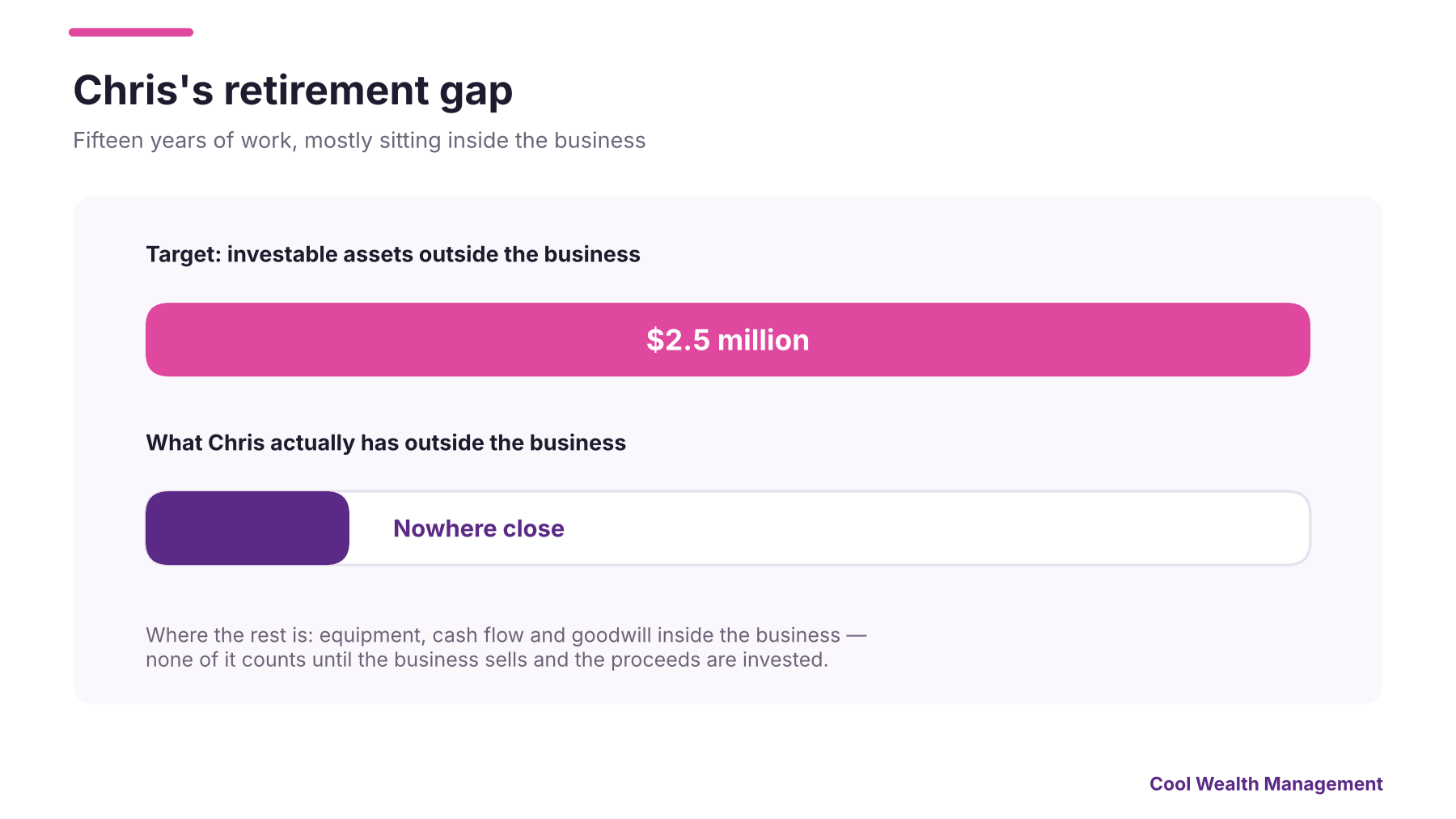
Chris isn't broke. Chris isn't failing. Chris just never did the math before — and doing the math is the whole point.
Why the number is worth knowing early
The earlier you know your number, the more levers you have. With ten or fifteen years of runway, a gap can be closed with steady contributions and compounding. With two years of runway, the same gap usually means working longer, spending less in retirement, or depending on a business sale going perfectly.
Should profit go back into the business, or out of it?
Before deciding where to put money outside the business, there's a question that comes first: should this money be leaving the business at all?
The case for reinvesting in your business
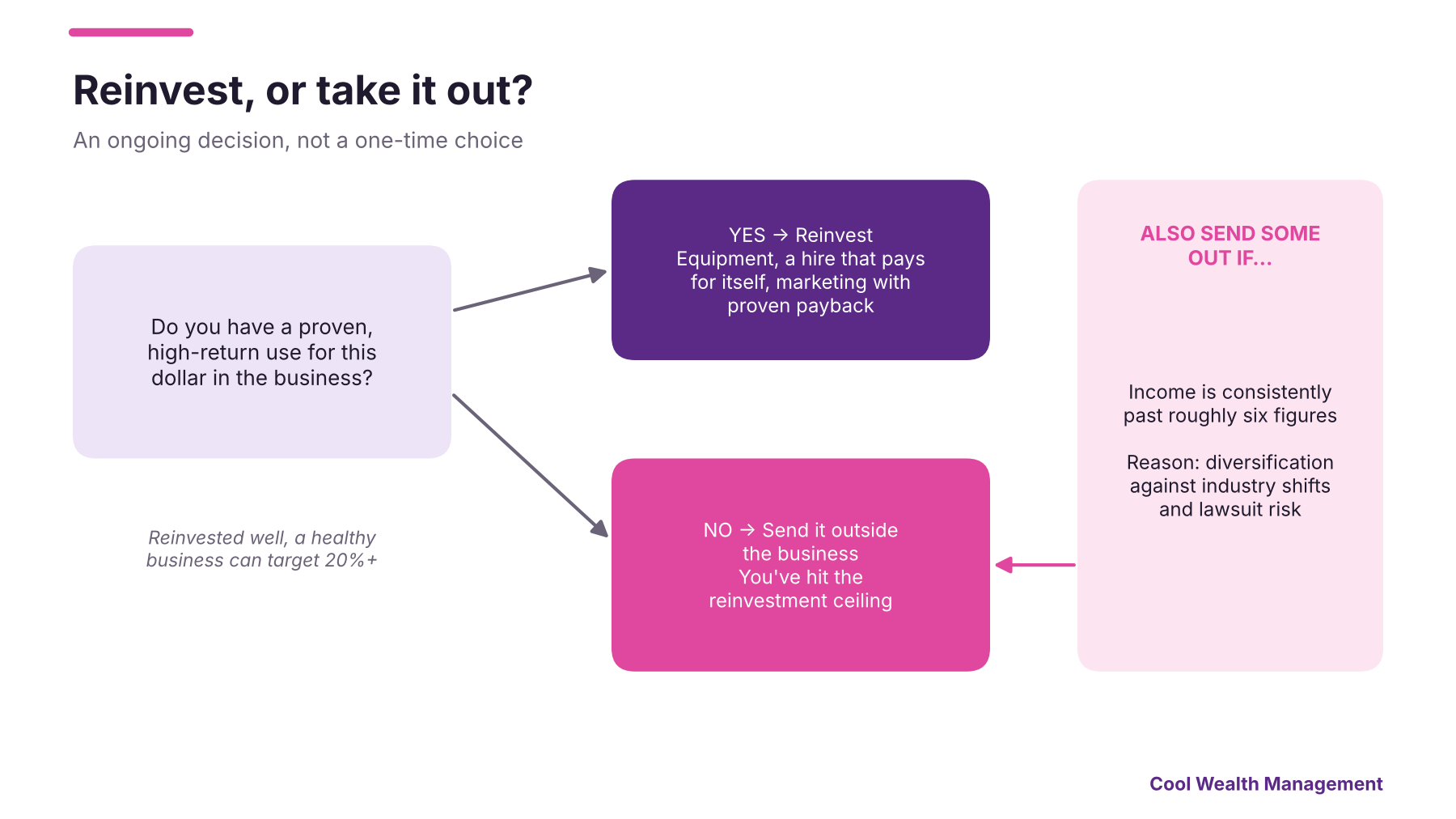
Here's the honest, slightly controversial answer. If your business is genuinely healthy, reinvesting profit back into it can often outperform almost anything you'd do with that same dollar in the market.
A well-run business can reasonably target returns of 20% or higher on money that's reinvested well. Depending on how it's deployed, that growth can come with real tax advantages, too. Dollar for dollar, that's a return most personal investment portfolios simply can't compete with.
Examples of proven, high-return reinvestment:
New equipment that directly increases capacity
A new hire who pays for themselves within months
Marketing spend with a demonstrated payback
If you've got a proven way to deploy capital like this, reinvesting is often still the higher-returning move — even once you're thinking seriously about retirement.
The reinvestment ceiling
That logic only holds up to a point. Every business eventually hits a ceiling where an extra dollar reinvested doesn't produce another 20% return.
Past that ceiling, money either sits as idle cash or gets spent on something that feels productive but doesn't move the needle. That's the signal. Once you're putting money into the business without a clear, proven path for what it will do there, it's time to start sending it outside the business instead.
Diversification: the reason that has nothing to do with returns
There's one more piece, and it matters even when the business genuinely could put the money to good use.
Once you're consistently past roughly six figures in income, it's generally worth setting some money aside outside the business on a regular basis — purely for diversification. Here's why:
Concentration risk. Your entire livelihood is already concentrated in one business, in one industry.
Industry shifts. Industries change, sometimes fast. Just ask anyone whose business model got reshuffled by a shift they didn't see coming.
Lawsuit risk. A single lawsuit can put a business, and everything reinvested into it, at risk. Money sitting safely outside the business is a different story.
That isn't a bet against your own business. It's simply not betting your entire net worth on one outcome.
It's an ongoing decision, not a permanent one
The real choice isn't "business or investments" forever. It's a decision you keep making:
Keep reinvesting where you have a genuinely proven, high-return use for the money.
Once you're past that point — or established enough that outside diversification makes sense on its own — start directing money outside the business in a deliberate order.
Where business owners actually put money outside the business
Say some of your money is headed outside the business — either because you've hit the ceiling on high-return reinvestment, or because you're deliberately setting some aside for diversification. Where should it go?
Why the business bank account is the default (and the problem)
A lot of owners default to leaving extra cash in the business bank account. It feels safe, and it's right there. The instinct makes sense.
It's also usually the least efficient place for long-term retirement money. It isn't growing, and depending on how the business is structured, it may not even be truly separate from business risk.
A general order to think through
Here's a rough hierarchy of what tends to make sense first for many business owners. Your specific order depends on your situation, which is exactly why this decision is worth a real conversation.
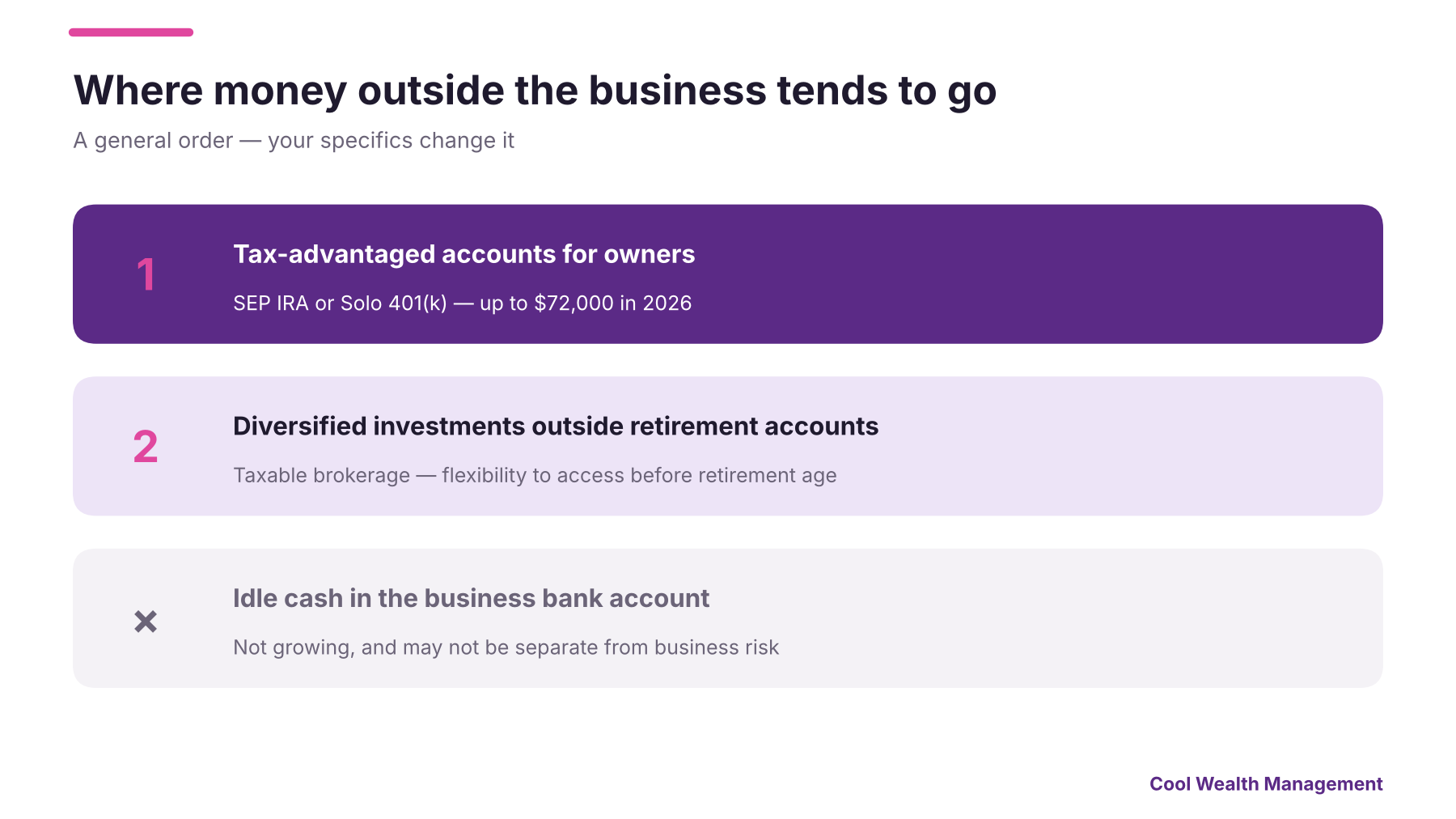
1. Tax-advantaged retirement accounts built for business owners
Start with accounts like a SEP IRA or Solo 401(k). These often allow contribution limits far beyond what a typical employee 401(k) allows. The IRS built them knowing business owners need to save faster, on a more compressed timeline, without decades of steady employer contributions behind them.
For 2026, the numbers look like this:
SEP IRA: up to $72,000, capped at 25% of compensation, with no catch-up contributions.
Solo 401(k): combined employee and employer contributions up to $72,000. The employee deferral portion alone is $24,500.
Solo 401(k) catch-ups: owners 50 and older can add $8,000, for a total of $80,000. Owners aged 60 to 63 get an enhanced $11,250 catch-up, for a total of $83,250.
For comparison: a Traditional or Roth IRA allows $7,500 in 2026, or $8,600 at age 50+.
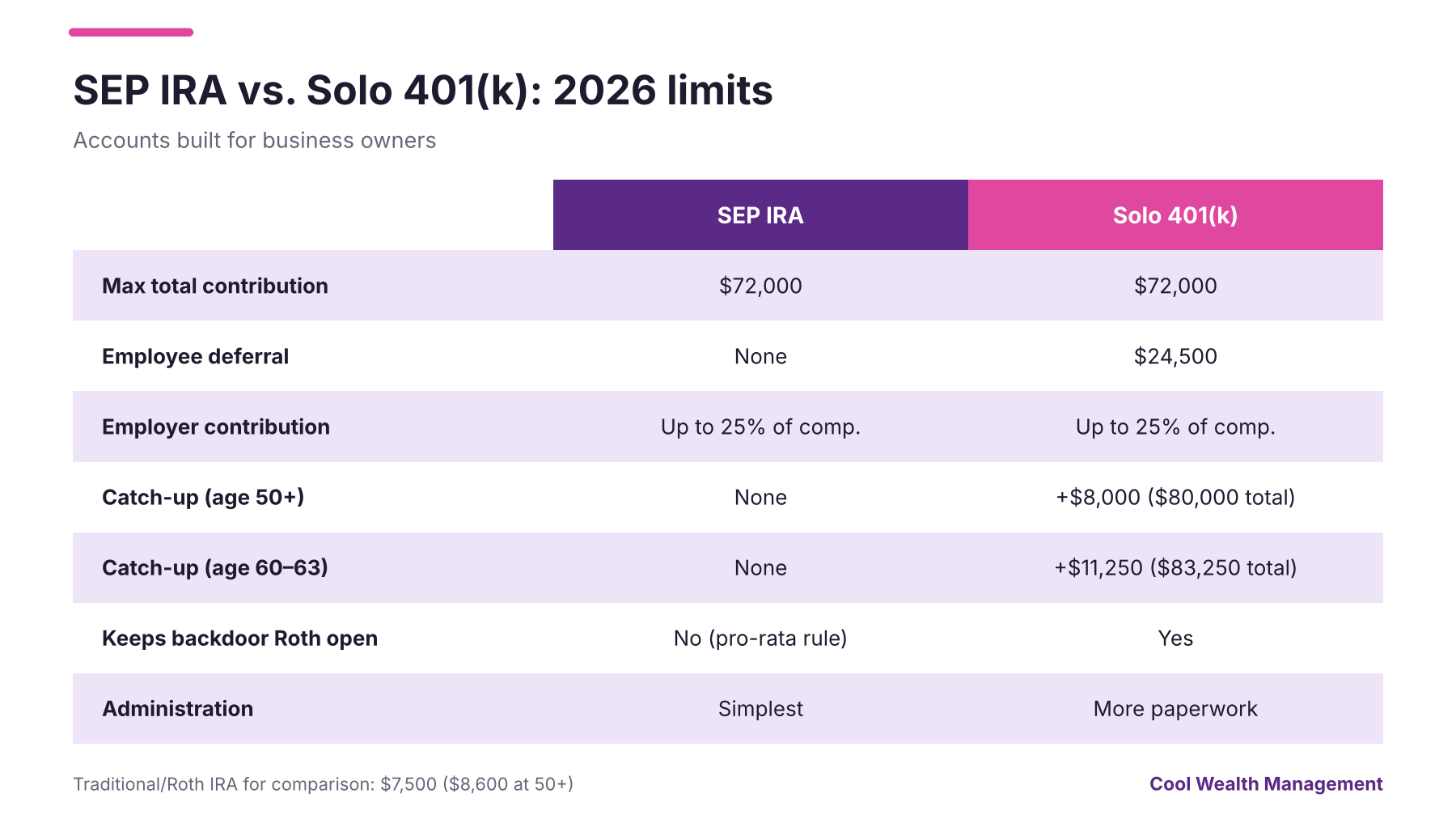
SEP IRA vs. Solo 401(k): which fits? A SEP IRA is simple to set up and administer. A Solo 401(k) adds an employee deferral on top of the employer contribution, so it often lets owners at lower or moderate income levels contribute more. A Solo 401(k) also doesn't count toward the IRA pro-rata calculation, which keeps the backdoor Roth IRA strategy available for higher earners. A Solo 401(k) is designed for owners with no full-time employees other than a spouse; once you have staff, the plan options change.
2. Diversified investments outside retirement accounts
Retirement accounts alone often aren't enough to hit bigger retirement numbers like Chris's $2.5 million. Building diversified investments in regular taxable brokerage accounts fills that gap.
Those accounts also give you flexibility. Money outside retirement accounts can be accessed on your own timeline, including before typical retirement age, without early-withdrawal rules getting in the way.
How should you be invested? It depends on the business
This is the part that trips people up most. How much risk you take, and what mix of assets you hold, is not a generic answer. It's definitely not the same answer for every business owner. It depends on three things:
How much of your net worth is already tied up in the business
How many years you have before you want to retire
Your own tolerance for watching account values move around
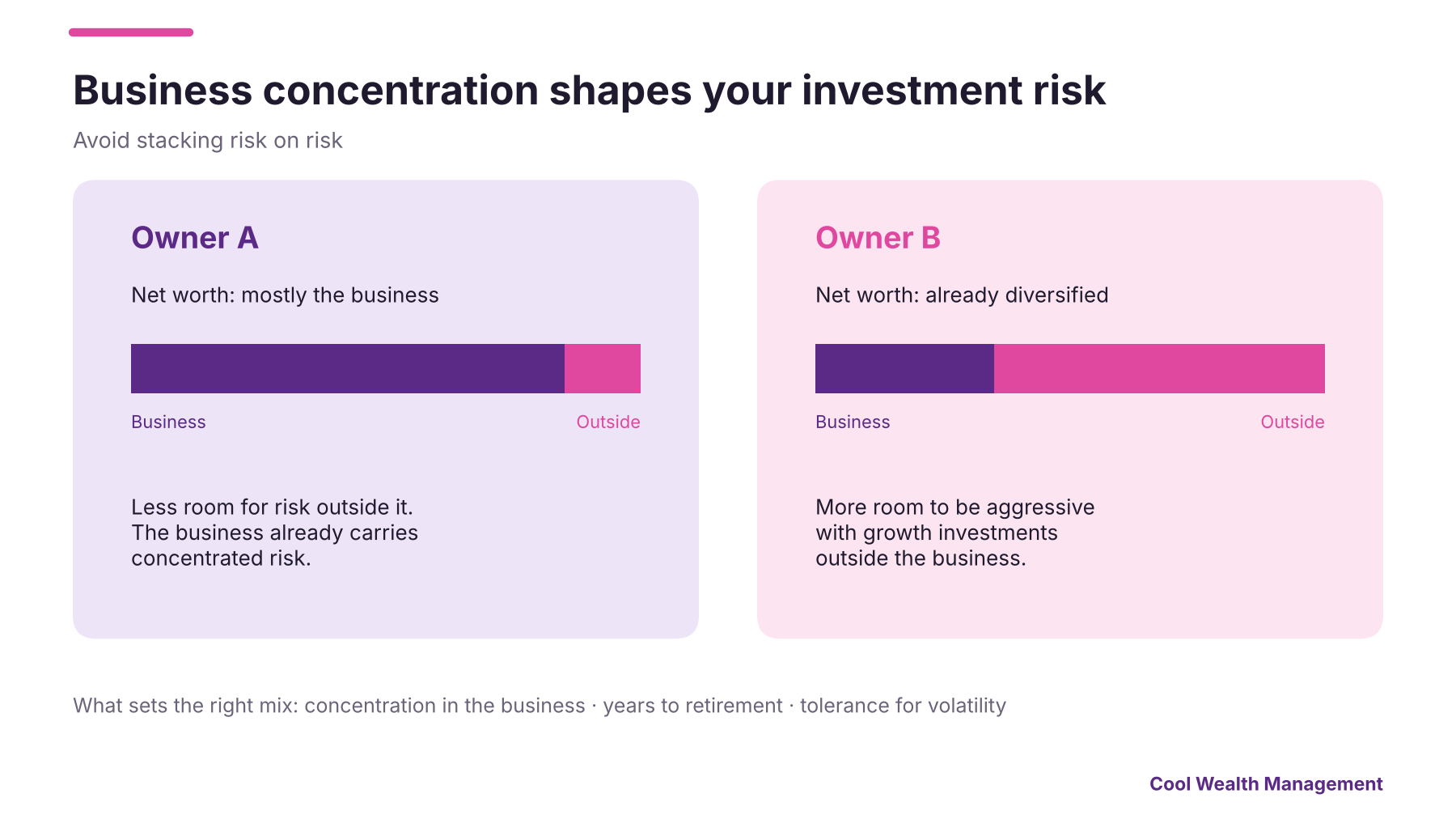
An owner whose entire net worth is the business probably shouldn't also take on maximum risk with the little they've invested outside it. That's stacking risk on risk.
An owner who is already well diversified outside the business has more room to be aggressive with growth.
That's why "how do I know which decision to make" has no one-size answer. It depends on your concentration, timeline, and comfort level — and getting the mix wrong in either direction is its own kind of expensive mistake.
The retirement prep business owners skip
Retirement readiness isn't just an investment question. A handful of other pieces quietly get skipped, and they matter just as much.
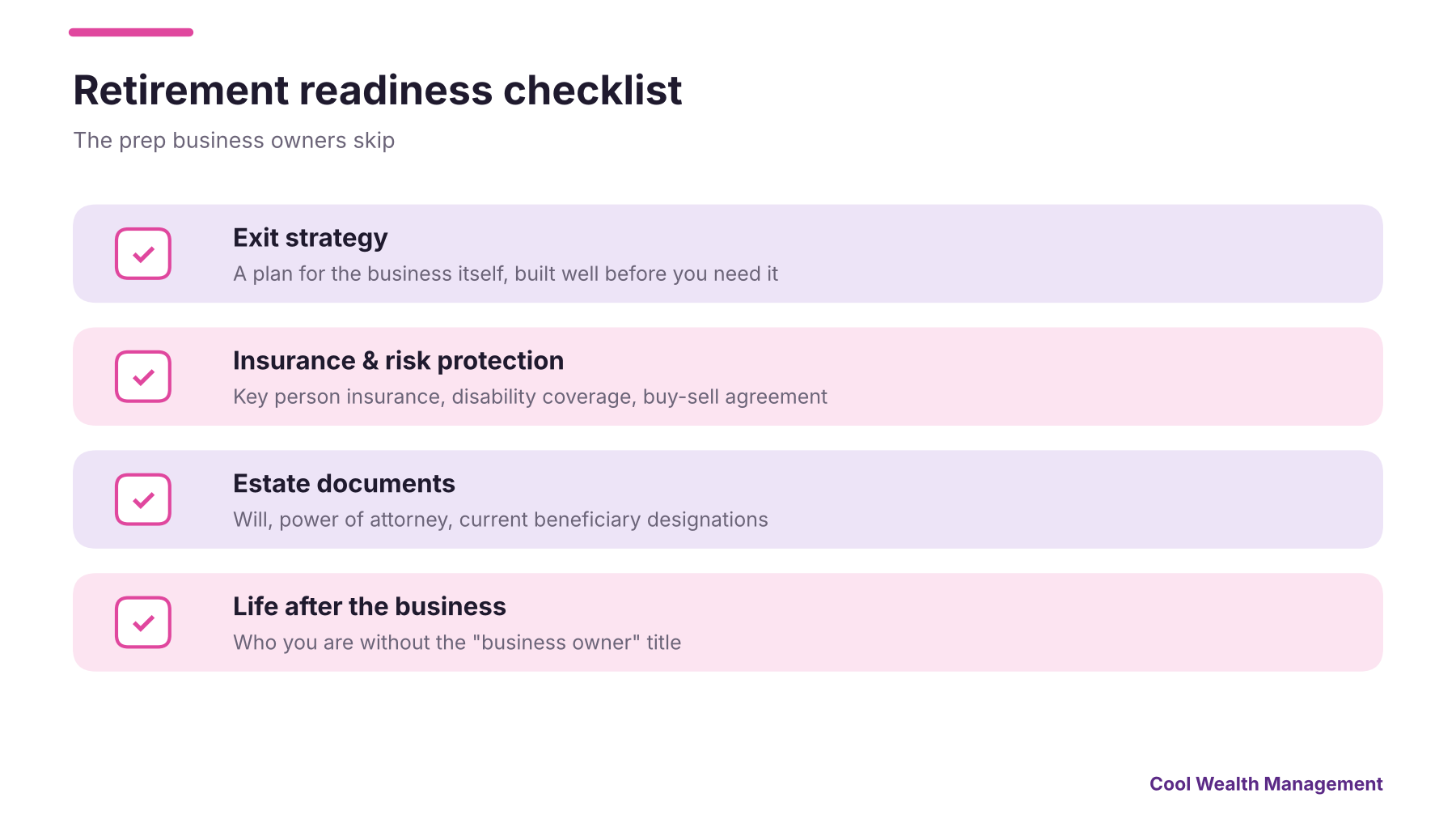
1. An exit strategy for the business itself
The business you're counting on to fund part of your retirement needs its own plan. That plan works best when it's thought through well before you need it — not scrambled together the year you decide you're done. (We cover this in depth in our exit planning video — [link to exit planning post].)
2. Insurance and risk protection
If something happens to you before you're ready to retire, does your family, or do your business partners, actually have a plan? Common pieces include:
Key person insurance, which protects the business if it loses the person it depends on most
Disability coverage, which protects your income if you can't work
A buy-sell agreement, if you have partners, so ownership transfers smoothly
None of this is fun to think about. That's exactly why it's usually the first thing skipped — right up until it's the one thing that was actually needed.
3. Updated estate documents
Your will, power of attorney, and beneficiary designations should reflect your current life, not whatever you filled out a decade ago and forgot about.
You'd be surprised how many successful business owners still have a beneficiary form on an old 401(k), at an old job, pointing to an ex.
4. The psychological side of retirement
Retirement isn't just a math problem. If your entire identity has been "the business owner" for twenty years, figuring out who you are without that title is its own project. It's worth starting well before your last day, not the week after.
Frequently asked questions
How much is my small business worth?
Most small businesses are valued as a multiple of profit. The multiple depends on your industry, growth rate, profit margins, and how dependent the business is on you as the owner. Because those factors vary so much, a professional valuation is the only way to get a real number rather than an estimate.
How much money do I need to retire as a business owner?
Work backward. Take the annual income you'd want in retirement and divide it by a safe withdrawal rate. At $100,000 a year and a 4% withdrawal rate, the target is $2.5 million in investable assets outside the business.
Can I count my business as my retirement plan?
Your business is an asset, but it only funds retirement once it's sold and the proceeds are invested. A sale depends on finding a buyer, getting your price, and timing it to your retirement date. Building assets outside the business reduces your dependence on all three.
Should I reinvest profits or invest outside my business?
Reinvest when you have a proven, high-return use for the money, such as equipment, hires, or marketing with a demonstrated payback. Once extra dollars stop producing strong returns, or once your income is consistently past roughly six figures, directing money outside the business adds diversification.
Is a SEP IRA or Solo 401(k) better for business owners?
Both allow up to $72,000 in 2026. A Solo 401(k) adds a $24,500 employee deferral and catch-up contributions, so it often allows larger contributions at lower or moderate incomes. A SEP IRA is simpler to administer. The better fit depends on your income, business structure, and whether you have employees.
What's the biggest retirement mistake business owners make?
Treating business value and retirement readiness as the same number. The second most common is skipping the non-investment pieces: an exit strategy, insurance, and updated estate documents.
The bottom line
Your business value matters, but it's one line on a much bigger balance sheet — not the whole plan.
The real question is whether you've built enough outside the business to fund the retirement you want. That starts with the backward math to find your real number.
Before sending money outside the business, check whether it still has a genuinely high-return home inside it. Once it doesn't, or once diversification alone justifies it, that money should follow a deliberate order built around your own concentration and timeline.
And the investments are only part of it. Insurance, estate documents, an exit strategy, and the mental shift away from "business owner" all belong in the same plan.
The owners who end up genuinely ready to retire aren't the ones who got lucky with a great sale. They're the ones who did this math years earlier and had time to act on what it told them.
