Section 179 vs. Bonus Depreciation: Which One Actually Saves You More?
You're about to buy a truck, a piece of equipment, or a new computer setup for the office, and a little voice in the back of your head says, "I can write this off."
Great, but which write-off?
Two completely different tax tools let you deduct big business purchases quickly: Section 179 and bonus depreciation. People lump them together all the time as if they were the same thing wearing two different hats. They aren't. Each has its own rulebook, the two interact in ways most business owners never hear about, and picking the wrong one can cost you real money. The same goes for never picking at all and letting your tax software default for you.
This guide covers how each one works, when you'd want one over the other, how to use them together, and the Arizona-specific wrinkle that local business owners need to know about.
The Quick Answer
Section 179 lets you choose, asset by asset, how much of a purchase to deduct this year, but your total deduction can't exceed your business income. Bonus depreciation isn't limited by income and can create a loss, but it applies to an entire class of assets at once. For many business owners, the best result comes from using both on purpose: Section 179 first for precise control, then bonus depreciation on the remainder, sized to the year that actually needs the deduction.
Why Section 179 and Bonus Depreciation Exist
When you buy a major business asset like equipment, a vehicle, machinery, or technology, the IRS normally won't let you deduct the full cost in year one. You have to spread the deduction over several years through regular depreciation (MACRS). The reasoning is that the asset will produce value for your business for years, so the deduction should be spread over those years too.
That makes sense in theory. In practice, if you just spent $60,000 on equipment, waiting five to seven years to fully deduct it doesn't do much for your cash flow today.
Section 179 and bonus depreciation both fix that problem. Each lets you accelerate the deduction, often writing off the entire cost in the year the asset goes into service. They share the same goal but follow very different rules to get there.
How Section 179 Works
Section 179 is the older and more flexible of the two, even though bonus depreciation tends to get more attention.
Under Section 179, you elect to deduct the cost of qualifying equipment or property in the year you place it in service, up to an annual limit. The feature that matters most to business owners is this:
Section 179 works asset by asset
You get to pick and choose. Say you bought three pieces of equipment this year. You can fully expense one, partially expense the second, and skip the third entirely. Section 179 works like a menu, not an all-or-nothing switch.
The catch: Section 179 can't create a loss
Section 179 is limited by your taxable income from active trades or businesses. You can't use it to push yourself below zero. If your business made $20,000 this year, you can't take a $40,000 Section 179 deduction. The deduction stops at your income, and anything you couldn't use carries forward to future years.
Planning note: for individuals, W-2 wages (yours, and your spouse's on a joint return) count toward this income limit along with business profit. An owner who also earns a paycheck may have more room than their business profit alone suggests.
Example: Nick's skid steer in a profitable year
Nick owns a construction company. He buys a new skid steer for $50,000 in a year when his business profit is $80,000.
Profit of $80,000: Nick can deduct the full $50,000 under Section 179 this year, since his income easily covers it.
Profit of $30,000: Nick is capped. He can deduct $30,000 now, and the remaining $20,000 carries forward to next year.
It's the same purchase with very different outcomes, depending entirely on how profitable the year was.
How Bonus Depreciation Works
Bonus depreciation follows a completely different set of rules.
Bonus depreciation doesn't care about your profit
There's no income limitation. You can use bonus depreciation to create or deepen a business loss, and depending on your overall tax picture, that loss may offset other income. That makes it a genuinely different strategic tool, not a backup version of Section 179.
Planning note: how much of a business loss can offset your other income depends on things like the excess business loss limit, your basis, and passive activity rules. This is a good reason to model it before assuming the full benefit.
Bonus depreciation applies by asset class
Section 179 lets you choose asset by asset. Bonus depreciation, by contrast, applies automatically to every qualifying asset in a class (for example, all 5-year property) unless you elect out of that entire class. You give up a lot of the fine-tuning Section 179 allows.
Example: Nick's skid steer in a rough year
Now change Nick's situation. His construction business shows a loss before the equipment purchase, but the old skid steer finally dies, so he buys (or finances) the same $50,000 replacement.
Under Section 179: Nick is stuck. With no business income, he gets no deduction this year, and the amount just carries forward.
Under bonus depreciation: Nick can take the full $50,000 deduction now, deepen his business loss, and potentially use that loss against other income.
In the same rough year, bonus depreciation produces a completely different outcome than Section 179 could.
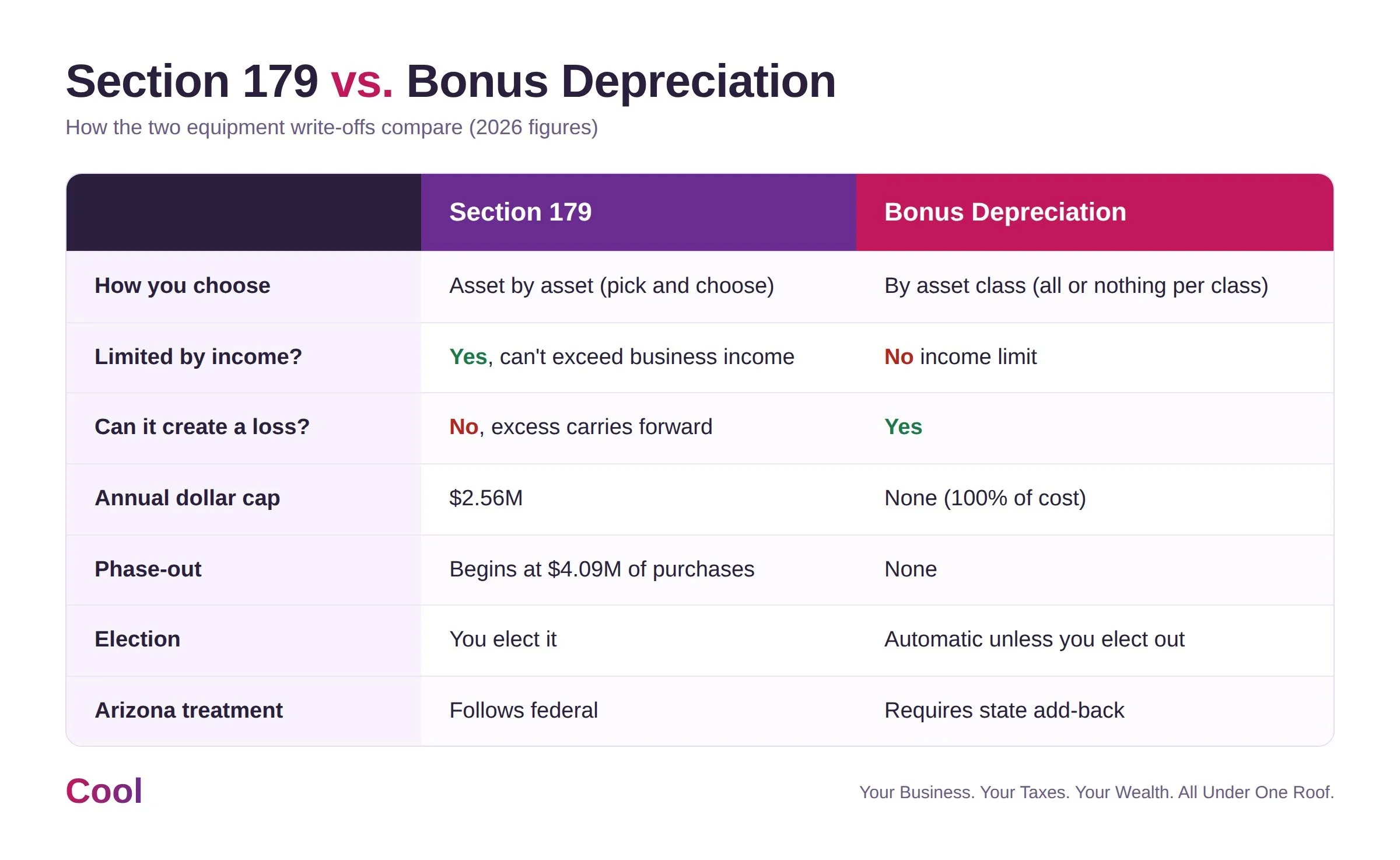
The 2026 Numbers
These figures change, so always confirm the current year's limits before you plan a purchase around them.
Section 179 maximum deduction (2026): $2,560,000
Section 179 phase-out begins (2026): $4,090,000 of qualifying property placed in service (the deduction shrinks dollar for dollar above that)
Section 179 heavy SUV cap (2026): $32,000 for SUVs rated 6,000 to 14,000 lbs gross vehicle weight
Bonus depreciation: 100%, made permanent by the 2025 tax law (the One Big Beautiful Bill Act) for qualifying property acquired after January 19, 2025
For context, 2025 limits were $2.5 million for Section 179 with a $4 million phase-out. Before the 2025 law, bonus depreciation had been phasing down from 100% toward zero, so if you've heard "bonus is going away," that information is out of date.
A Quick Word on Vehicles
Trucks and SUVs are among the most common purchases business owners want to write off, and they come with a few extra rules:
The vehicle generally has to be used more than 50% for business to qualify for either Section 179 or bonus depreciation.
Heavy SUVs (6,000 to 14,000 lbs GVWR) are subject to the $32,000 Section 179 cap noted above, but bonus depreciation can often cover the rest of the cost.
Lighter passenger vehicles fall under separate annual "luxury auto" depreciation limits, which cap first-year deductions far below the purchase price.
Your deduction is also only as good as your mileage and usage records. If you can't document business use, the write-off is hard to defend.
So Which One Actually Saves You More?
The honest answer is that it depends on your numbers, and the smartest move is often using both strategically instead of picking a favorite.
A general framework:
Solidly profitable with specific assets to accelerate? Section 179 gives you more control.
Low-income year, or want to create a loss that offsets other income? Bonus depreciation may do more, precisely because it isn't capped by profit.
Stacking Section 179 and bonus depreciation
You don't have to choose just one. The typical order is:
Apply Section 179 first, up to the amount that makes sense for your income and goals.
Apply bonus depreciation to what's left (or elect out of bonus for a class).
Let regular depreciation handle any remaining basis over future years.
Used together, these let you decide exactly how much deduction to take this year and how much to save for later.
More deduction isn't always better
This is the part most people miss. A deduction is worth the most in the year your income is taxed at the highest rate. Sometimes taking a smaller deduction now and saving the rest for a bigger-income year is the better move.
Example: Priya's dental practice expansion
Priya owns a dental practice and buys $200,000 of new equipment for an expansion. Thanks to a one-time contract, this year's profit is unusually high, and she expects next year to return to normal.
Rather than deducting everything now just because she can, Priya and her tax advisor use a deliberate combination: enough Section 179 and bonus depreciation to significantly reduce this year's unusually large tax bill, while intentionally leaving some depreciation for future years when her income normalizes.
That isn't leaving money on the table. It's putting the deduction where it earns the most.
The Arizona Twist: Bonus Depreciation Doesn't Carry Over to Your State Return
If you own a business in Arizona, this matters.
Arizona follows the federal Section 179 rules, but it does not follow federal bonus depreciation. If you take bonus depreciation on your federal return, you'll generally have to add it back on your Arizona return and depreciate the asset on a separate state schedule.
In practice:
A deduction that looks like 100% in year one federally may be spread out over several years for Arizona purposes.
You end up tracking two depreciation schedules (federal and state) for the same asset.
For some Arizona owners, leaning on Section 179 rather than bonus depreciation, where the income limit allows, can keep the federal and state treatment aligned and simplify the bookkeeping.
If you operate in multiple states, each state has its own conformity rules, which is one more reason this decision shouldn't be left on autopilot.
The Mistake Most Business Owners Make
The most common mistake here has nothing to do with the math. Most business owners never actually make this decision.
They buy the equipment, hand the receipt to their accountant or drop it into their software, and whatever the default is becomes the outcome. There's no strategy and no conversation about which year needs the deduction more. It runs on autopilot.
Depreciation elections aren't exactly dinner-party conversation. But this is real money decided by a checkbox, and most owners have never been asked the question, let alone answered it deliberately.
If you bought equipment this year and aren't sure which method was used, or whether anyone thought about it strategically, have a five-minute conversation before your return is filed, not a "huh, interesting" moment after it's too late to change.
Frequently Asked Questions
Can I use Section 179 and bonus depreciation in the same year?
Yes. You can use both in the same year and even on the same asset. Section 179 is generally applied first, and bonus depreciation then applies to the remaining cost unless you elect out.
Can Section 179 create a business loss?
No. Section 179 is limited to your taxable income from active trades or businesses (for individuals, that includes W-2 wages). Any amount you can't use carries forward to future years. Bonus depreciation has no income limit and can create a loss.
Is bonus depreciation still 100% in 2026?
Yes. The 2025 tax law permanently restored 100% bonus depreciation for qualifying property acquired after January 19, 2025.
Does Arizona allow bonus depreciation?
No. Arizona conforms to federal Section 179 but decouples from bonus depreciation, so bonus depreciation taken on your federal return generally has to be added back and depreciated separately for Arizona.
Does used equipment qualify?
Generally, yes. Both Section 179 and bonus depreciation can apply to used property, as long as it's new to you and you didn't acquire it from a related party.
Do financed purchases qualify?
Yes. What matters is when the asset is placed in service in your business, not whether you paid cash or financed it.
The Takeaway
Section 179 gives you asset-by-asset control but is capped by your business income.
Bonus depreciation ignores income, can create a loss, and moves by whole asset class.
In Arizona, bonus depreciation creates a state add-back that Section 179 doesn't.
The real answer to "which saves more?" is usually both, used intentionally, in the right proportion for your specific year.
The question isn't which tool is objectively better. It's making sure this is a decision, not a default.
Let's Make the Decision on Purpose
At Cool Wealth Management, we handle bookkeeping, tax filing, and tax planning for business owners in Scottsdale, Tempe, and across the Phoenix area. That includes modeling your equipment purchases before you file, so your depreciation strategy fits this year and the next few.
Your Business. Your Taxes. Your Wealth. All Under One Roof.
