How to Calculate Your Business's Real Enterprise Value (And Why Your Books Might Be Ruining It)
Most business owners have no idea what their business is actually worth.
They hear about a competitor selling for millions and assume they'll get a similar number. Then it's time to sell, bring on an investor, or apply for a loan, and they find out the business is worth far less than they expected.
Usually, the problem isn't the business. It's the financials.
In this article, we'll walk through how enterprise value is calculated, what buyers actually pay for, and why messy bookkeeping can cost you far more than a bookkeeping service ever would.
Why Business Valuation Matters Even If You're Not Selling
For most business owners, the company is their single largest asset. Yet it's often the one they understand the least in dollar terms.
Knowing your enterprise value matters well before a sale. It comes into play when you are:
Selling your business to a third party, employee, or family member
Bringing on investors and negotiating how much equity to give up
Buying out a partner at a fair price
Estate planning and deciding how to transfer the business
Applying for financing, since lenders look at the same numbers buyers do
Measuring whether you're building wealth, not just earning income
If you don't know what your business is worth today, you can't track whether it's growing more valuable over time.
What Is Enterprise Value?
Business value isn't what you think it's worth. It's what a qualified buyer is willing to pay.
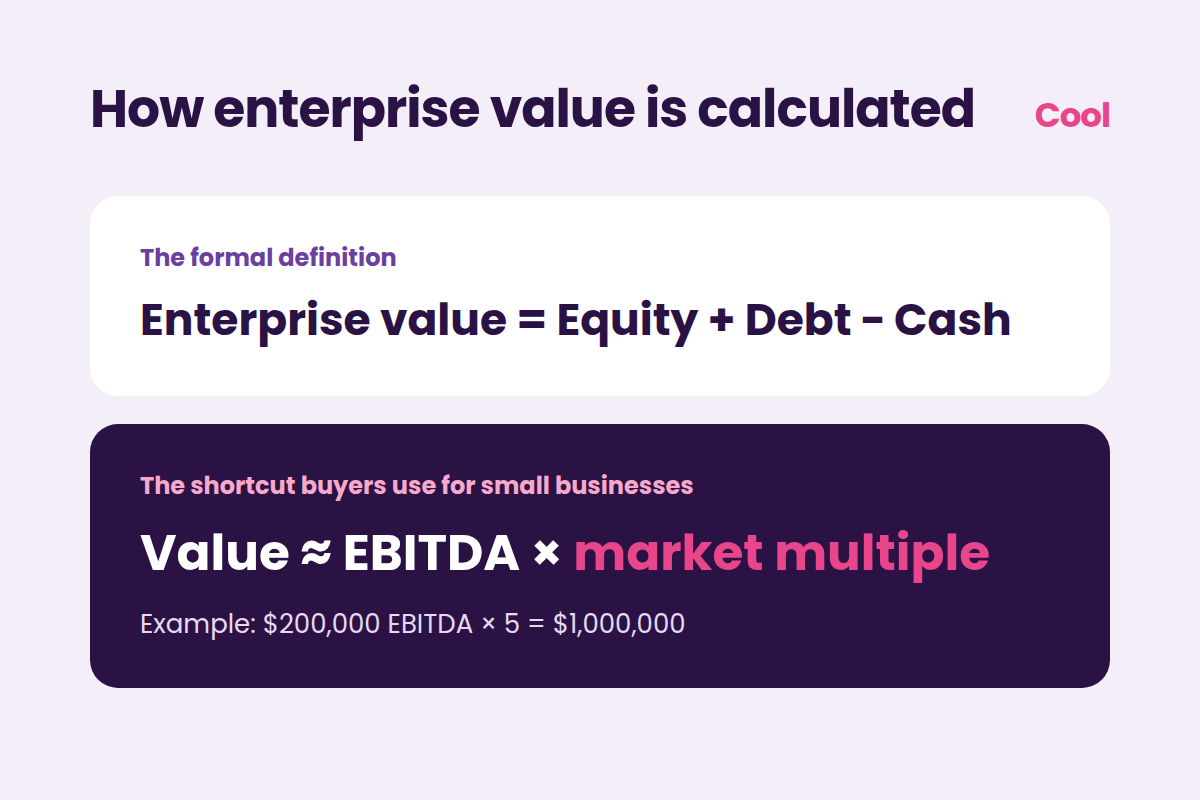
The formal definition of enterprise value is:
Enterprise Value = Equity Value + Debt − Cash
Equity value is the value belonging to the owners.
Debt includes loans, lines of credit, and other interest-bearing obligations.
Cash and cash equivalents are subtracted because a buyer effectively gets them back.
Enterprise value represents the value of the operating business itself, independent of how it's financed. That's why two companies with identical operations but different amounts of debt can have the same enterprise value but very different equity values.
Why this matters for you as a seller: most small business deals are structured "cash-free, debt-free." The buyer pays for enterprise value, then the seller pays off business debt and typically keeps the cash. What lands in your pocket is closer to equity value, before taxes and transaction costs.
The shortcut most owners use
In practice, lower middle-market businesses are usually discussed with a simpler formula:
Business Value ≈ EBITDA × Market Multiple
This is a simplification, but it's how most buyers, brokers, and lenders start the conversation.
What Is EBITDA?
EBITDA stands for Earnings Before Interest, Taxes, Depreciation, and Amortization.
In plain English, it's a measure of how much profit the core operations of your business produce before accounting for financing, taxes, and non-cash charges.
Buyers use EBITDA because it:
Removes financing decisions. A buyer will likely finance the purchase differently than you did.
Removes tax differences. Entity structure and owner tax situations vary.
Makes comparison easier. Businesses of different sizes and structures can be evaluated side by side.
A simple example
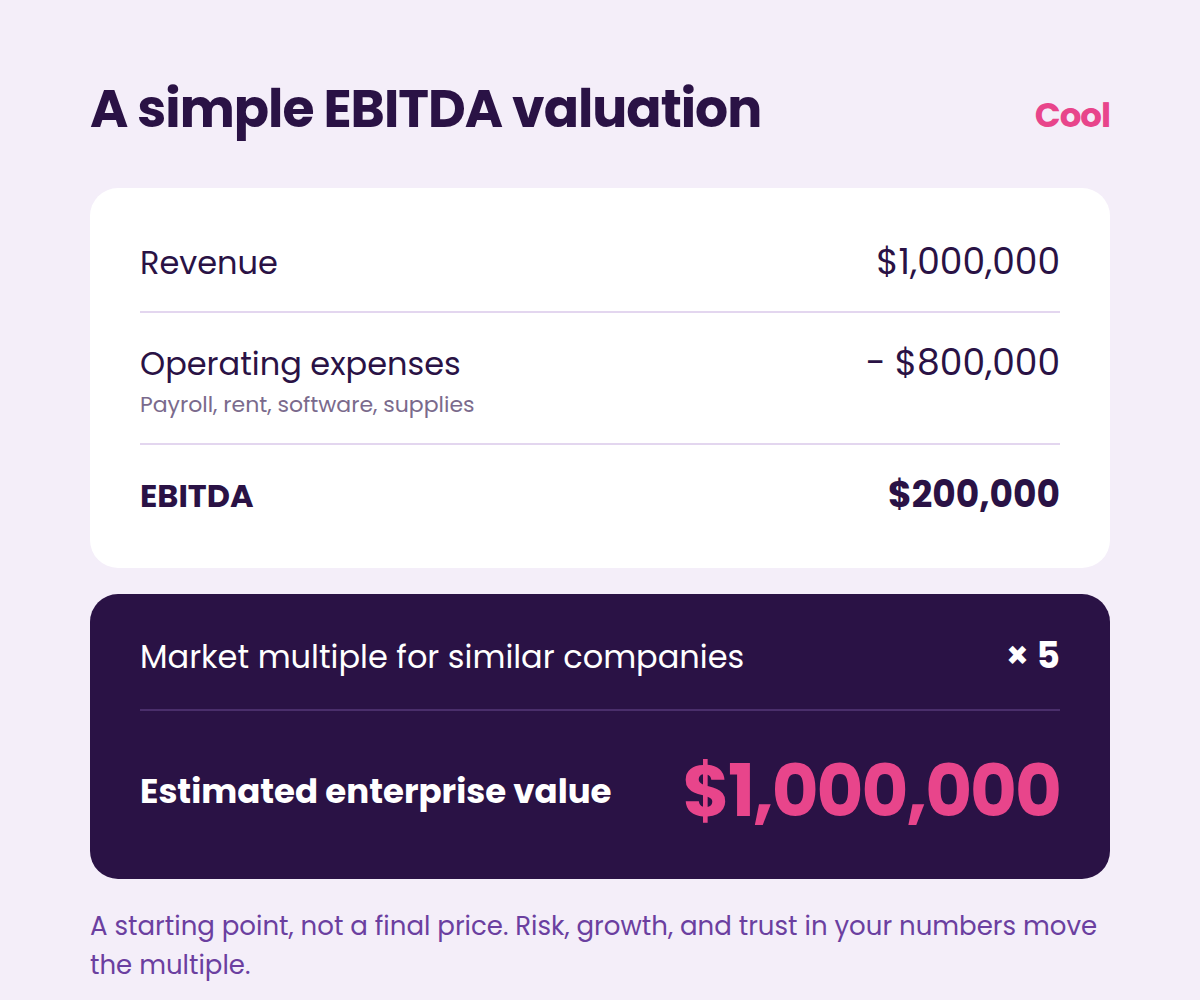
That $1 million is a starting point, not a final price. The multiple itself moves based on risk, growth, industry, and, as you'll see next, how much a buyer trusts your numbers.
For many owner-operated businesses, especially those earning under roughly $1 million a year, buyers often use Seller's Discretionary Earnings (SDE) instead of EBITDA. SDE adds the owner's salary and personal perks back into profit, reflecting the total financial benefit to one owner-operator. SDE multiples are typically lower than EBITDA multiples, so it's important to know which one a buyer is applying before comparing offers.
Either way, the principle is the same: value is a multiple of verifiable earnings.
Why Your Books Can Destroy Your Valuation
Poor bookkeeping creates uncertainty, and buyers price uncertainty as risk.
Common problems we see:
Personal expenses mixed with business expenses
Missing or unrecorded transactions
Incorrectly categorized expenses
Unreconciled bank and credit card accounts
Revenue recorded in the wrong period
No monthly financial statements
When buyers don't trust your numbers, they don't just ask more questions. They lower the price, restructure the deal with earnouts or seller financing, or walk away entirely.
The add-back problem
Owners often run personal expenses through the business and assume a buyer will "add them back" to earnings. Buyers will, but only if those expenses are clearly documented. An undocumented add-back is just a claim. If a buyer can't verify $40,000 of add-backs, that $40,000 disappears from your earnings, and at a 5× multiple, $200,000 disappears from your price.
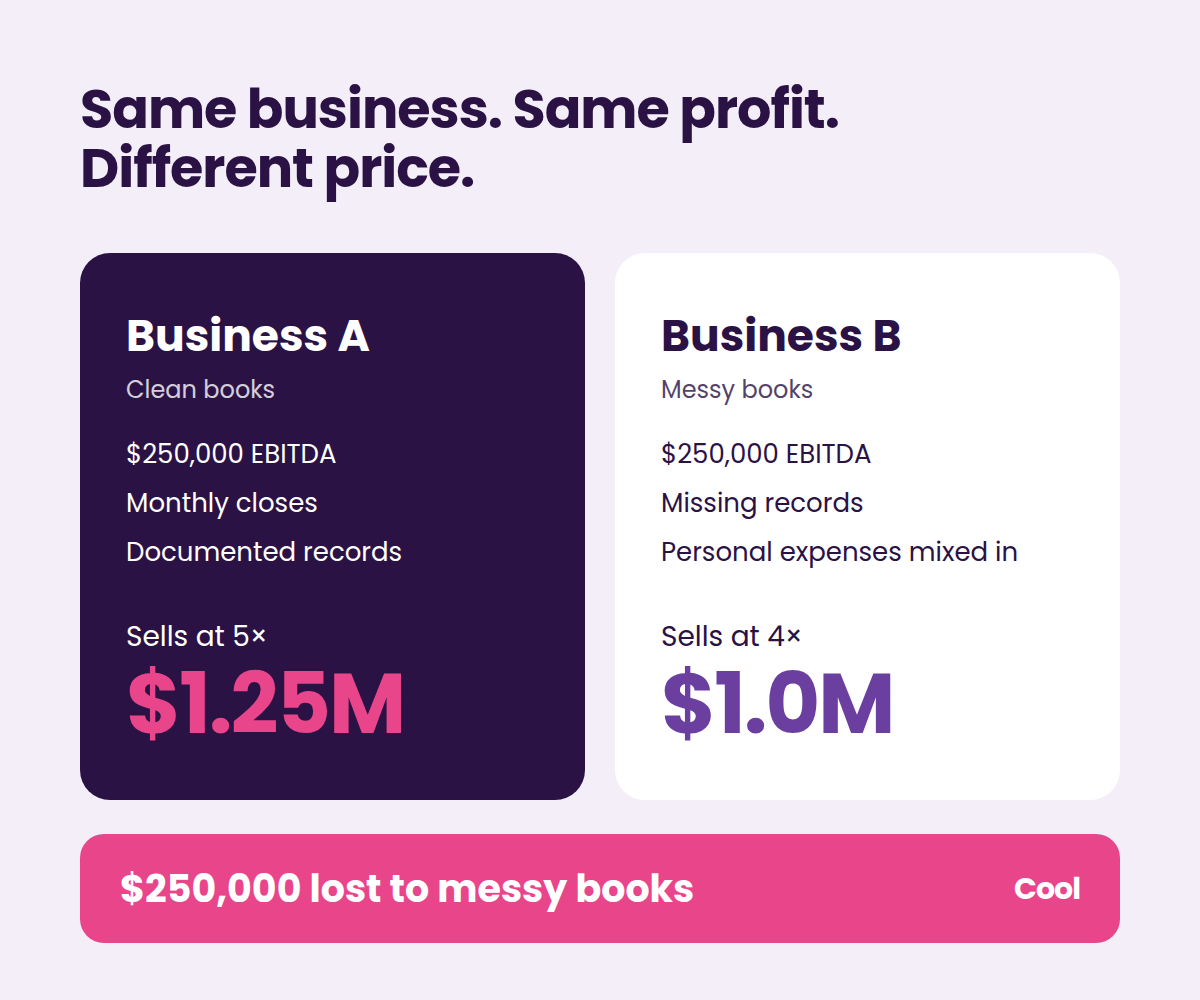
Same business, different price
Business A
EBITDA: $250,000
Clean financials, monthly closes, strong documentation
Sells for 5× EBITDA
Value: $1,250,000
Business B
Same customers, same profit
Messy books, missing records, personal expenses everywhere
Buyer discounts the multiple to 4×
Value: $1,000,000
Same business. $250,000 lower valuation.
That gap is far larger than what most businesses would spend on years of professional bookkeeping.
What Actually Increases Enterprise Value?
Growing revenue helps, but it's not what buyers pay a premium for. They pay for predictable, verifiable, transferable profit.
Buyers look for:
Consistent profits
Predictable cash flow
Reliable financial statements
A diversified customer base with low customer concentration
Recurring revenue
Strong margins
Documented processes
Low dependence on the owner
Clean tax filings
Notice how many of these start with accurate bookkeeping. You can't prove consistent profits, strong margins, or low customer concentration without clean financial records to back them up.
Common Valuation Mistakes Business Owners Make
Mistake #1: Thinking revenue determines value
A $3 million business with thin margins can be worth less than a $1 million business with strong, consistent profits. Buyers pay for earnings, not top-line sales.
Mistake #2: Mixing personal and business expenses
It lowers reported profit, weakens your add-back case, and makes every number in your financials harder to trust.
Mistake #3: Waiting until you're ready to sell to clean up the books
Buyers typically want to see at least three years of financial history. Cleaning up one year right before a sale doesn't fix the two years before it, and a rushed cleanup can raise more red flags than it resolves. The best time to get your books in order is years before you plan to exit.
Frequently Asked Questions
How do I calculate the enterprise value of my small business?
The most common approach is to multiply your EBITDA (or SDE for smaller owner-operated businesses) by a market multiple based on comparable sales in your industry. Formally, enterprise value equals equity value plus debt minus cash.
What is a typical EBITDA multiple for a small business?
Multiples vary widely by industry, size, growth, and risk. Smaller businesses generally trade at lower multiples than larger ones, and businesses with recurring revenue, low owner dependence, and clean financials command higher multiples.
Does bookkeeping really affect business valuation?
Yes. Buyers discount for uncertainty. Unreliable financials can lower your multiple, eliminate undocumented add-backs, push the deal toward earnouts or seller financing, or end the deal entirely.
How far in advance should I clean up my books before selling?
Ideally at least three years, since buyers and lenders usually review multiple years of financial statements and tax returns.
What is the difference between enterprise value and equity value?
Enterprise value is the value of the operating business regardless of how it's financed. Equity value is what belongs to the owners after accounting for debt and cash.
The Bottom Line
Your bookkeeping isn't just about taxes. It's the foundation for:
Better business decisions
Better financing terms
Better tax planning
Higher business value
If buyers can't trust your numbers, they won't pay top dollar.
Ready to Build a More Valuable Business?
At Cool Wealth Management, we help business owners across Scottsdale, Tempe, and the greater Phoenix area get accurate financial statements, reduce their tax bill, and build long-term wealth. Your Business. Your Taxes. Your Wealth. All Under One Roof.
Whether you need to clean up years of messy books, prepare for a future sale, or build a tax strategy that supports your long-term goals, we'd be happy to help.
