If your bookkeeping system right now is a bank app, a shoebox, and a vague sense of dread, you're not alone.
Every year, a lot of business owners say "I'll get the books cleaned up in January." And every year, a lot of them are saying it again in March.
This guide walks through exactly how to catch up on bookkeeping before tax season, step by step, so the books stop being a source of dread and the return actually gets filed on time.
I'm Grady, founder of Cool Wealth Management. I'm a CFP®, a CFA, and an Enrolled Agent, and I do bookkeeping cleanup for business owners all the time. I have seen things. I once saw a business owner categorize their dog's vet bill as "marketing." To be fair, the dog was very photogenic.
Why Catch-Up Bookkeeping Matters
Can't your tax preparer just figure it out? Technically, yes. But a tax return is only as good as the numbers that go into it. When the books are a mess, one of three things usually happens:
Missed deductions. You were entitled to them, but nobody could find them.
Overpaying. When the numbers are unclear, the safest guess is usually the expensive guess.
An extension. And then the whole cleanup happens in a panic in September instead.
It goes beyond taxes, too. If you ever want a business loan, a line of credit, or to sell the business someday, the first thing anyone asks for is clean financials.
Here's the full process at a glance:
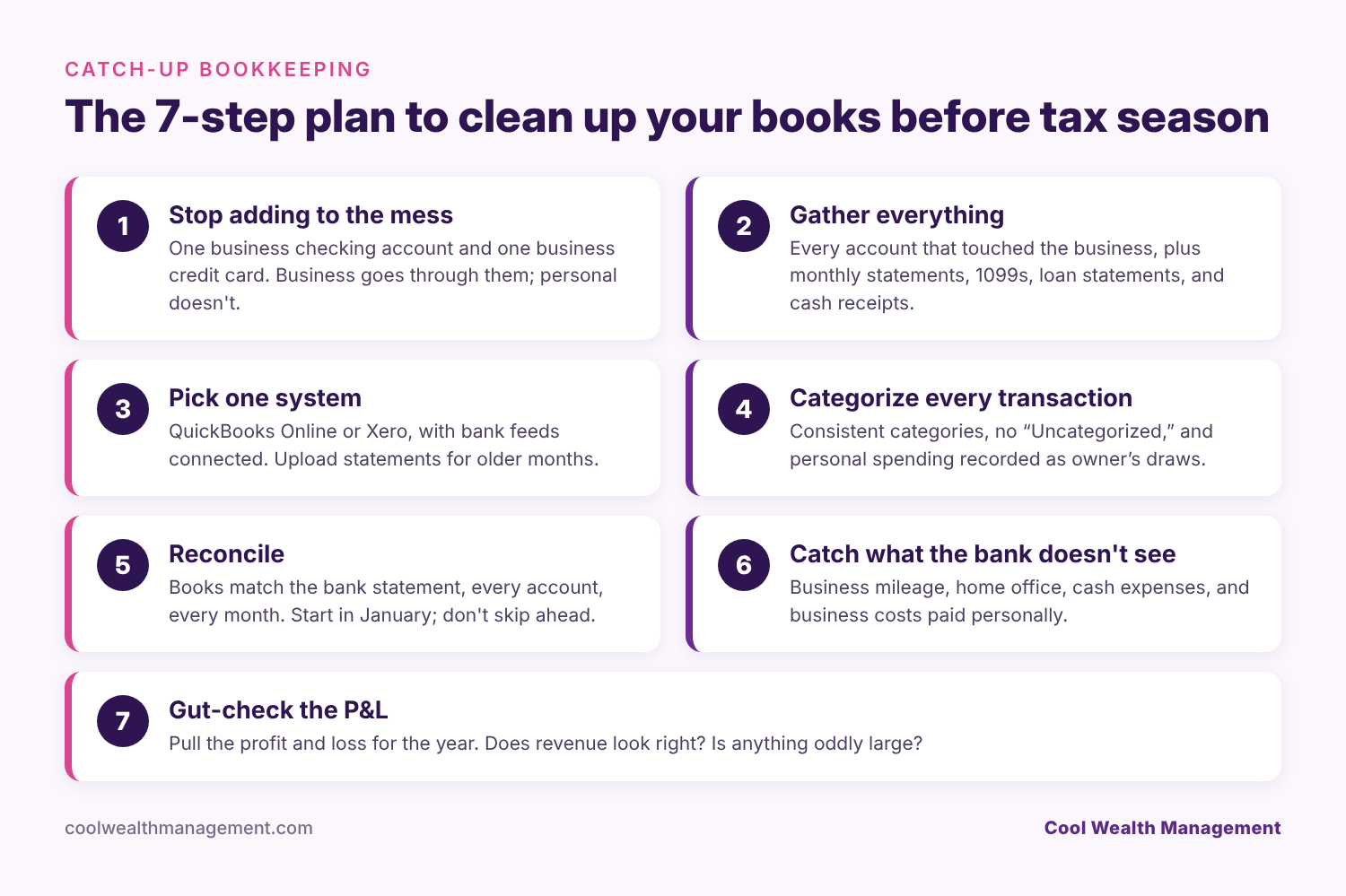
Step 1: Stop Adding to the Mess
Before cleaning up the past, the mess has to stop growing. If business and personal spending are running through the same account or the same credit card, that's the first thing to change.
The fix is simple: a dedicated business checking account and one business credit card. Everything business goes through those. Everything personal does not.
This one change cuts future bookkeeping time more than any software ever will.
Step 2: Gather Everything
Make a list of every account that touched the business this year:
Bank accounts
Credit cards
PayPal, Venmo, Stripe, and Square
Loans
Payroll
Then download the statements for every one of them, for every month. Yes, every month. This is the boring part. Put on a podcast.
While you're at it, grab any 1099s you've received, any loan statements, and whatever receipts you have for cash purchases.
Step 3: Pick One System
The books need one place to live. QuickBooks Online and Xero are the most common, and either one is fine. Personally, I use QuickBooks Online with my clients, and it's my preferred platform.
What's not fine is a spreadsheet, plus a notes app, plus the receipts folder in your car.
Connect your accounts to the software so transactions flow in automatically. One catch: bank feeds don't always go back as far as you need, so older months may have to be uploaded from statements or imported manually.
Step 4: Categorize Every Transaction
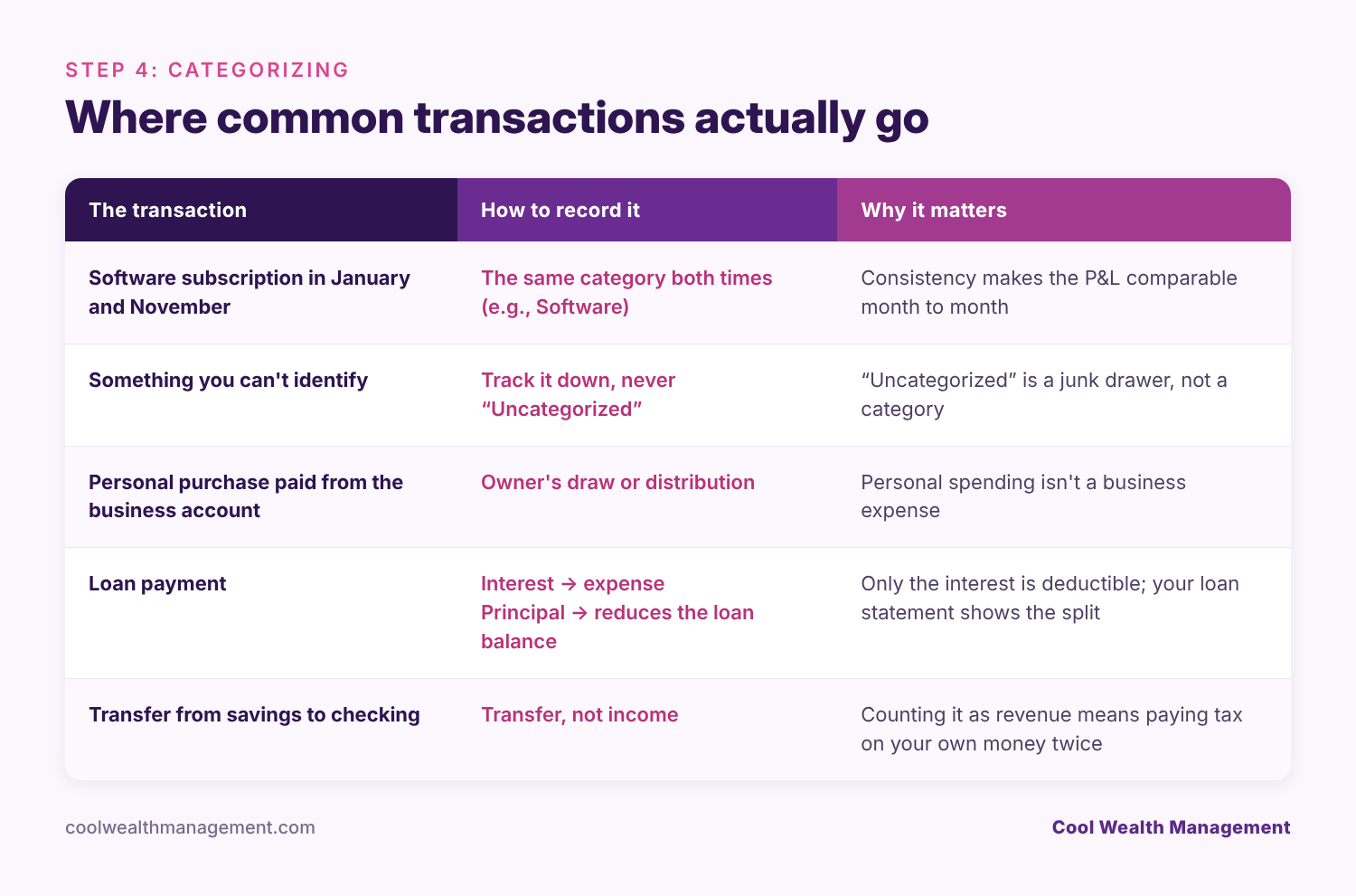
This is the real work. Every transaction gets a category, and a few rules make it far less painful:
Be consistent. If software subscriptions go in "Software" in January, they go in "Software" in November too.
Don't hide things in "Uncategorized." That's not a category. That's a junk drawer.
Personal spending isn't a business expense. If something personal went through the business account, it's recorded as an owner's draw or distribution, not as an expense. I know it's tempting. The answer is still no.
Loan payments get split. The interest is a deductible expense. The principal is not. Your loan statement shows the split.
Transfers aren't income. Moving money from savings to checking is not revenue. Count it as revenue and you'll pay taxes on your own money twice. Do not recommend.
Step 5: Reconcile Every Account, Every Month
Reconciling is the step everyone skips, and it's the one that matters most.
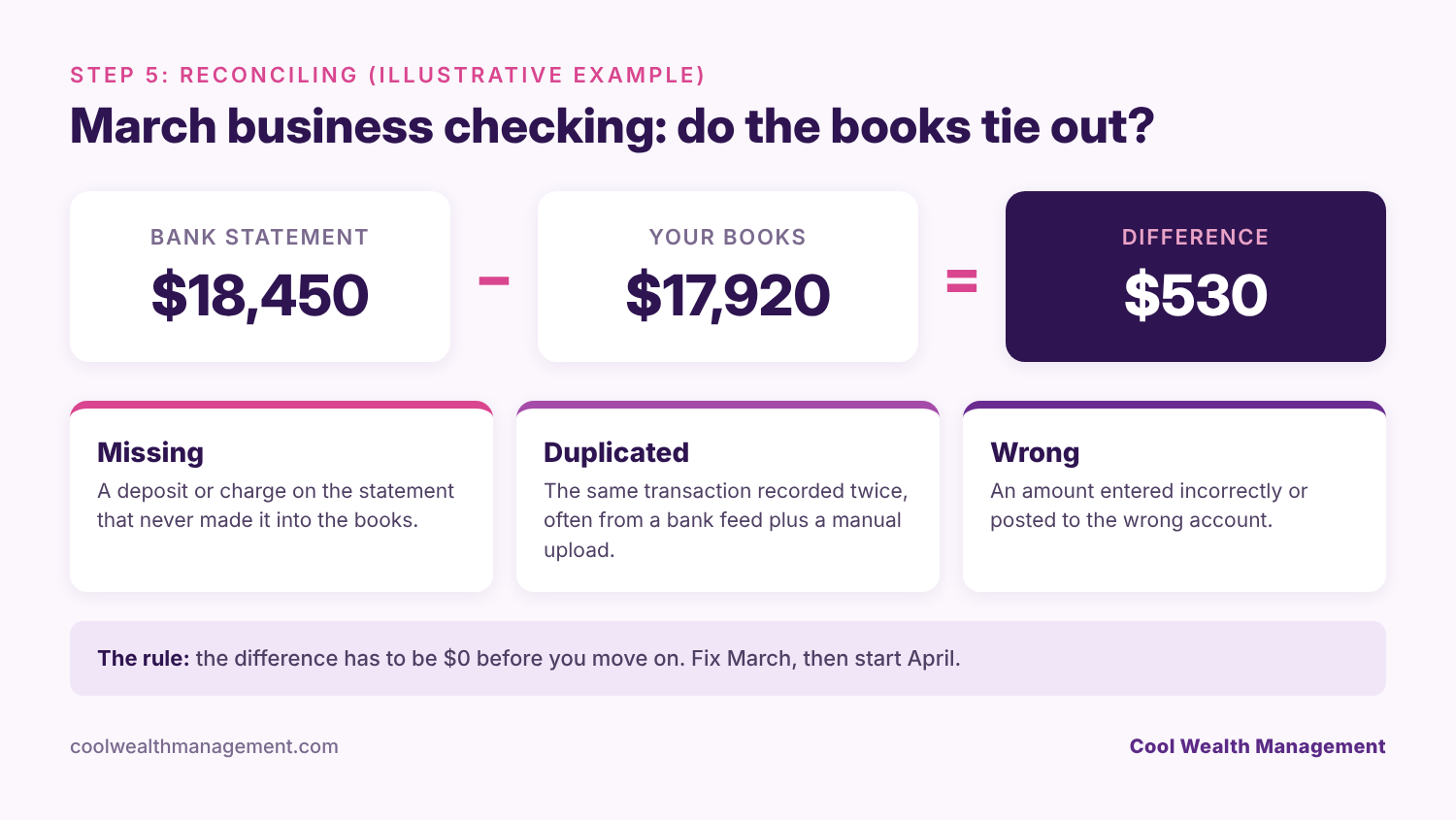
Reconciling means checking that the balance in your books matches the balance on your bank statement, for every account, for every month. If they don't match, something is missing, duplicated, or wrong.
Categorizing without reconciling is like counting your money without checking if it's all there.
Start with January and move forward. Don't move on to the next month until the current one ties out.
Step 6: Catch What the Bank Doesn't See
Some deductions never show up in a bank feed:
Business mileage
A home office
Cash expenses
Things you paid for personally that were really for the business
Pull those in now, while you're already in the weeds. These are some of the most commonly missed deductions I see, and they add up fast.
Step 7: Gut-Check Your Profit and Loss Statement
When you're done, pull a profit and loss statement for the year. Then look at it and ask: does this make sense?
Is revenue roughly what you expected? Is anything wildly bigger than it should be?
If your "Meals" category is higher than your rent, either you're very successful or something is miscategorized. Usually it's the second one.
Should You Catch Up on Bookkeeping Yourself or Hand It Off?
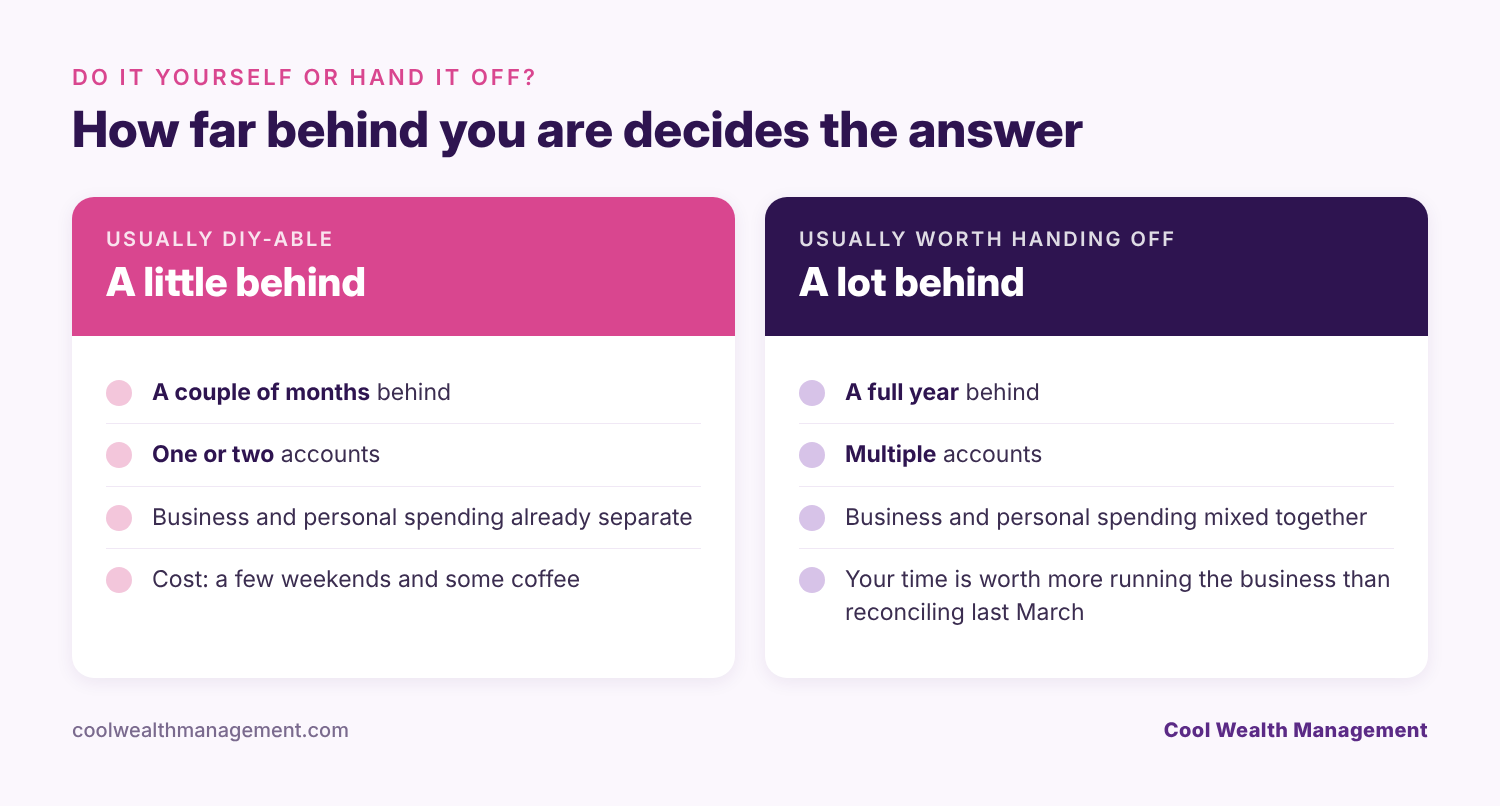
Honest answer: if you're only a couple of months behind and you have one or two accounts, you can absolutely do this yourself with a few weekends and some coffee. It's a big time commitment, but it's possible.
If you're a full year behind, with multiple accounts and personal and business spending mixed together, it's usually worth handing off. Not because you can't do it, but because your time is worth more spent running the business than reconciling March of last year.
Frequently Asked Questions
What is catch-up bookkeeping?
Catch-up bookkeeping is the process of bringing past months of business records up to date: gathering every statement, categorizing every transaction, and reconciling each account so the books match the bank.
How long does it take to catch up on bookkeeping?
It depends on how far behind you are and how many accounts are involved. A couple of months with one or two accounts can usually be done over a few weekends. A full year with multiple accounts and mixed personal spending takes considerably longer.
Can I file my taxes if my books aren't caught up?
You can, but the return is only as good as the numbers going into it. Messy books usually lead to missed deductions, overpaying, or filing an extension.
Are transfers between my business accounts taxable income?
No. Moving money from savings to checking is a transfer, not revenue. Recording it as income means paying tax on your own money twice.
Is a loan payment a business expense?
Only part of it. The interest portion is a deductible expense; the principal is not. Your loan statement shows the split.
Let's Get Your Books Caught Up
At Cool Wealth Management, we do bookkeeping cleanup at $100 an hour, and ongoing monthly bookkeeping starting at $200 a month, so you never end up this far behind again. See the full breakdown on our pricing page.
And because we also handle tax filing, your books and your tax return are done by the same team. No lost handoffs. No mystery spreadsheets.
Once your books are clean, you might find more cash sitting in the business than you thought. That's the next topic: what to actually do with it.
Your Business. Your Taxes. Your Wealth. All Under One Roof.
