Nine Months Behind on the Books: How One Contractor Got Current and What It Uncovered
He called in March, which is the month contractors call.
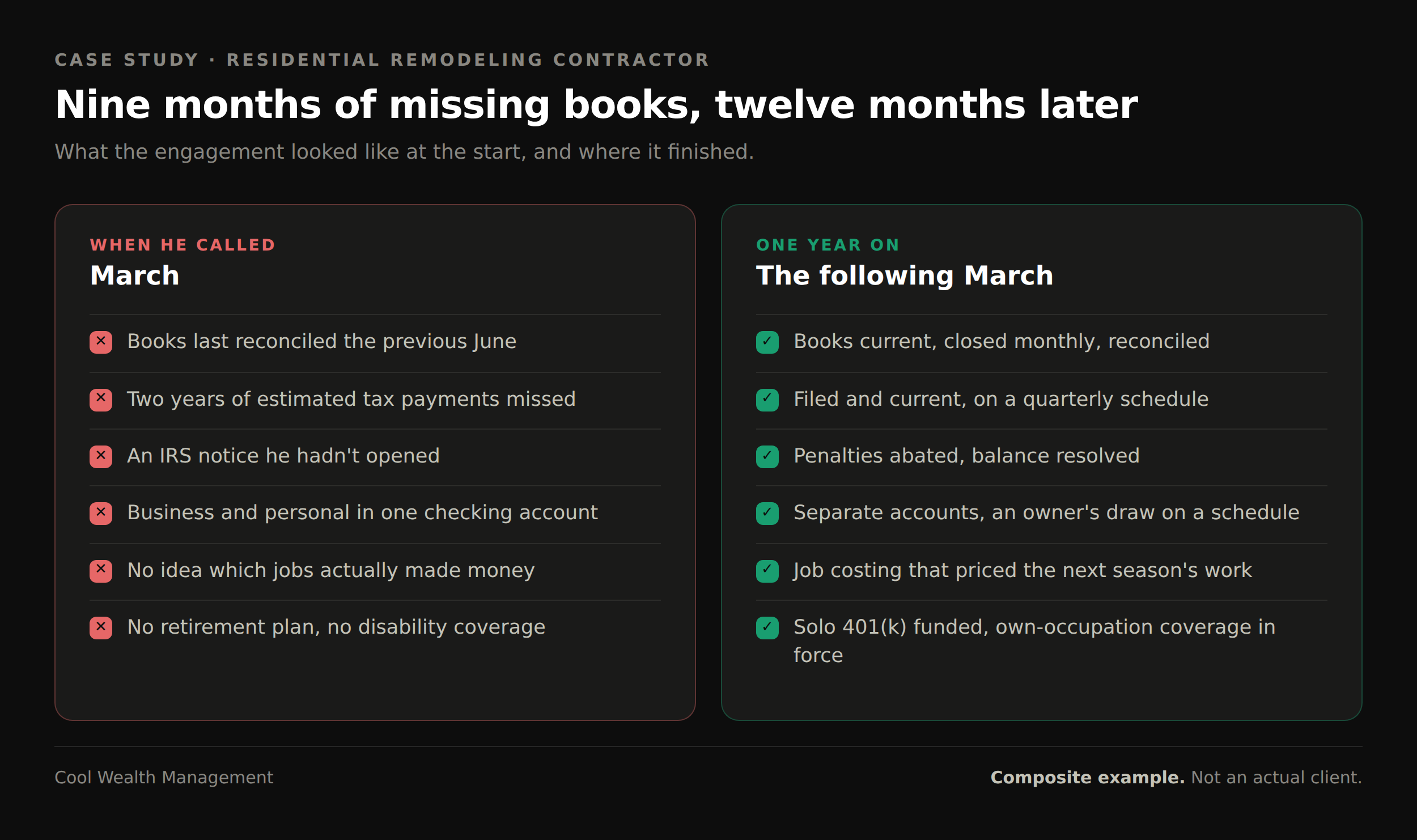
Nine months since anyone had reconciled the books. Two years of estimated tax payments he'd meant to make and hadn't. An envelope from the IRS on the kitchen counter that he hadn't opened, because opening it would make it real.
He runs a residential remodeling company. Four employees, a rotating bench of subs, about $680,000 in revenue. He is good at the work. He was not behind because he is careless — he was behind because in June a big job went sideways, and the choice every week after that was between doing the bookkeeping and doing the thing that generates money. He made the same choice a busy owner makes every time.
By March it had compounded into something he couldn't face on a Sunday afternoon.
What being behind actually costs
Most owners assume the cost of messy books is the tax penalty. The penalty is real, but it's rarely the expensive part.
The expensive part is that you're making decisions blind. He'd raised his prices eight percent the previous spring, and he could not tell us whether it had helped, because he had no reliable read on job costs. He thought two of his crews were roughly equally profitable. He was wrong about that, and had been wrong for two seasons.
The second cost is that everything else waits. You can't have a conversation about retirement contributions when nobody knows what the profit is. You can't set an owner's salary. You can't decide whether the entity structure makes sense. Every planning conversation depends on the numbers being true, so when the numbers aren't true, the planning simply doesn't happen, for years at a stretch.
The third cost is the one he felt at 2 a.m., which is that he'd stopped knowing whether he was doing well.
The cleanup
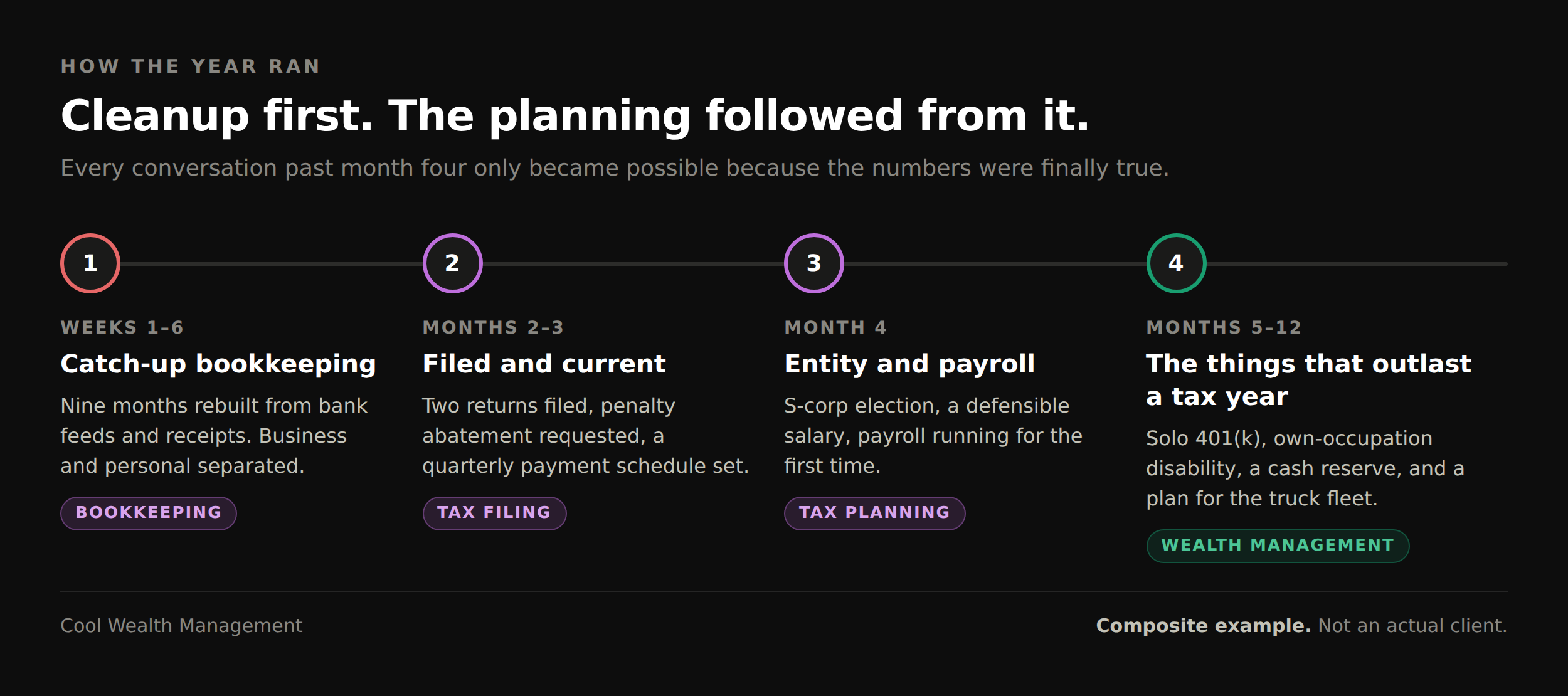
Six weeks, working backward from the bank feeds.
The mechanics are unglamorous. Pull every transaction since the last clean month. Match what can be matched automatically, then sort the rest by hand. Chase down the ones with no paper. Separate the personal charges, and there were a lot of personal charges, because he'd been running everything through one checking account since he started.
Two things made it faster than he expected. His bank data goes back years, so nothing was truly lost. And he was honest about what he didn't know, which saves an enormous amount of time compared with owners who guess.
At the end of six weeks he had nine months of clean books, a real profit-and-loss statement, and the part he wasn't expecting, job-level costing for the previous season.
Then the returns. Two years filed. The IRS notice turned out to be a proposed assessment based on gross receipts with none of his expenses, which is what happens when you don't file: they assume your revenue is your profit. The actual number, once filed properly, was a fraction of what the notice claimed. First-time abatement took care of most of the penalties. What remained went on a payment schedule alongside a quarterly estimate he could actually hit.
That's the whole front end of this engagement. Bookkeeping and tax filing. It solved the problem he called about.
It also produced the thing that made everything else possible: a set of numbers he could trust.
What the clean books showed
Once the year closed properly, his net profit before paying himself was about $185,000 on $680,000 of revenue. Roughly 27 percent. Healthy for remodeling, and higher than he'd guessed.
Three things followed from that number.
He was paying self-employment tax on all of it. As a single-member LLC, every dollar of that $185,000 ran through self-employment tax at 15.3 percent up to the Social Security wage base. About $26,000 a year, before income tax.
One crew was carrying the company. The job costing showed a spread of nearly fourteen points of gross margin between his two crews on comparable work. Not a people problem, an estimating problem. One crew's jobs were being bid by him in the truck between appointments, and the other's were being bid at a desk. He changed how he bids. That's a bookkeeping insight that pays more than most tax strategies.
He had no retirement plan and no disability insurance. Forty-one years old, a body he depends on to earn, four people depending on him, and nothing behind it.
The entity decision, honestly
The S-corp conversation is the one every contractor has heard about from another contractor at a supply house. The version they hear is: pay yourself a salary, take the rest as distributions, save 15.3 percent on the distributions. On $185,000 of profit with a $92,500 salary, that sounds like about $12,000 a year.
It isn't $12,000. It's about $6,300.
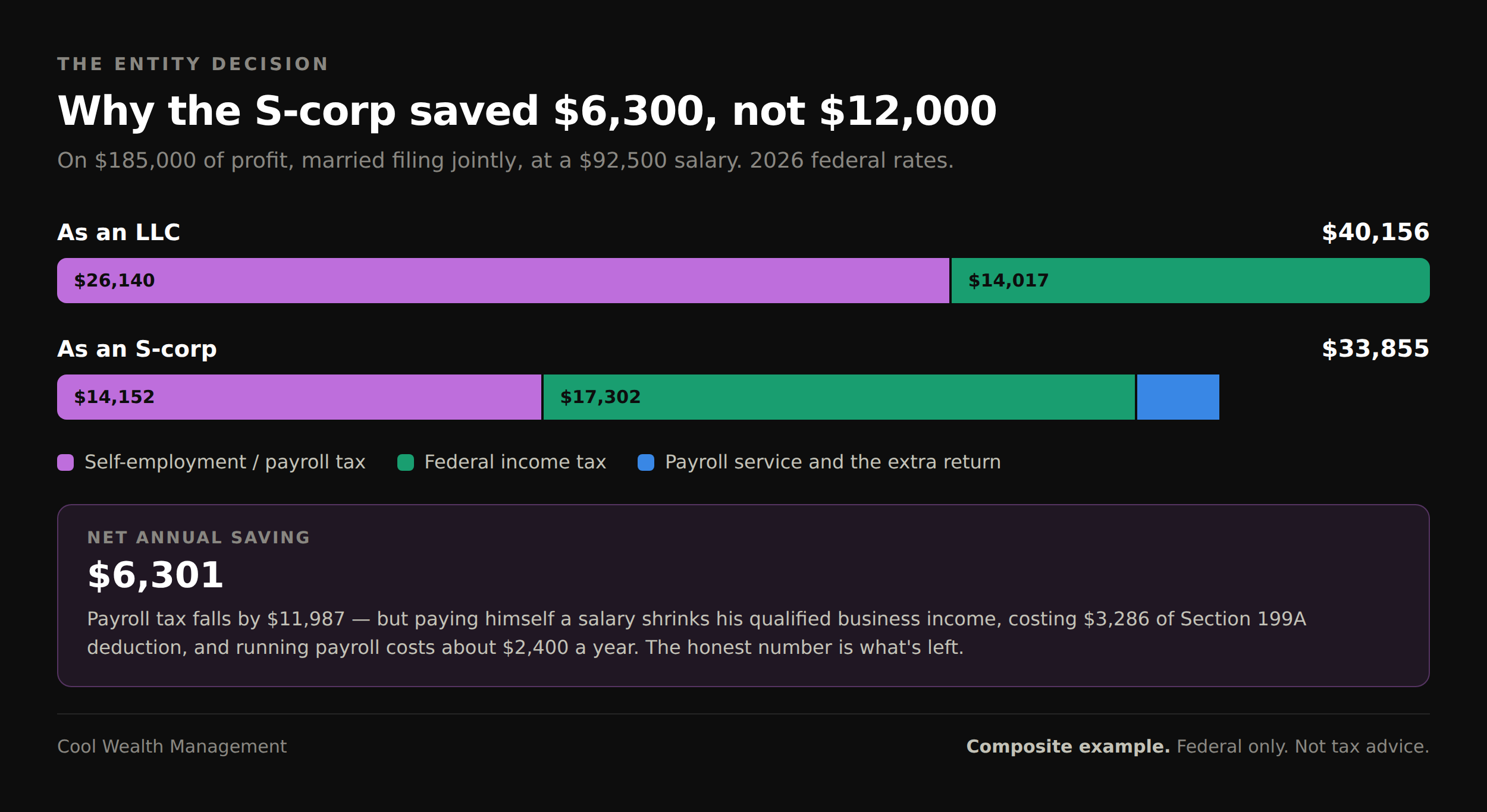
Payroll tax does fall by nearly $12,000. But paying yourself a W-2 salary shrinks your qualified business income, which shrinks your Section 199A deduction by about $3,300 — so your income tax goes up. And running payroll properly, with the extra corporate return, costs around $2,400 a year. What's left is roughly $6,300.
That's still worth doing. It's real money, every year, for filing a form and running payroll. But it's half of what he'd been told, and he should hear the honest number from us rather than discover it later. An advisor who quotes you the $12,000 is either not doing the math or hoping you won't.
(If you want to run this for your own numbers, our S-corp calculator does exactly this arithmetic, including the 199A offset most calculators leave out.)
The things that outlast a tax year
Here is where the engagement stopped being about last year and started being about the next twenty.
The retirement plan. Setting a W-2 salary did something besides save payroll tax: it opened a solo 401(k). Against the $7,500 he could have put in an IRA, the plan gives him room for $24,500 of his own deferral plus an employer contribution of up to 25 percent of salary, about $47,600 of tax-deferred capacity in 2026. He isn't filling it. He put in $30,000 the first year, which is $30,000 more than the year before.
Disability insurance. This is the one nobody wants to talk about and the one that matters most for a man who earns with his hands. An own-occupation policy, which pays if he can't do his job rather than any job. For a healthy forty-one-year-old it runs a few thousand a year. Set against a $185,000 income stream that stops entirely if he tears a rotator cuff, it is the highest-value thing we did all year, and it doesn't show up in any tax calculation.
A cash reserve with a purpose. Remodeling revenue moves with the season and with one or two big jobs. We sized a reserve against his fixed monthly costs rather than a generic three-months rule, and he now knows what number means he can turn down bad work, which is worth more than the interest it earns.
A plan for the trucks. Three vehicles on staggered replacement, funded on a schedule instead of financed in a panic when one dies.
Where he ended up
Twelve months later: books closed monthly, filings current, quarterly payments automatic, penalties resolved. An entity structure that fits, saving a real if unglamorous $6,300 a year. A retirement account with something in it. A disability policy in force. A bidding process that stopped losing him fourteen points on half his jobs.
He came for the bookkeeping. That was the right reason to call — it was the problem burning a hole in his week, and it needed solving before anything else could happen.
But the bookkeeping was never the point. It was the thing that made the numbers true, and true numbers are what every other decision rests on.
If this sounds familiar
If you're behind — a quarter, a year, longer — you're not unusual and you're not in trouble yet. The owners who get hurt are the ones who wait for it to feel manageable before they make the call. It doesn't become manageable on its own.
We start with a conversation about where the books actually stand. No judgment about how far behind they are; we've seen further.
This is a composite example built from patterns we see across many engagements. It is not an actual client, and it is not a promise of similar results. Figures are illustrative, use 2026 federal rates, exclude state taxes, and are not tax advice. Cool Wealth Management is a registered investment adviser. Consult a qualified tax professional about your own situation.
