Her First $195,000 Year Came With a $51,854 Tax Bill She Hadn't Saved For
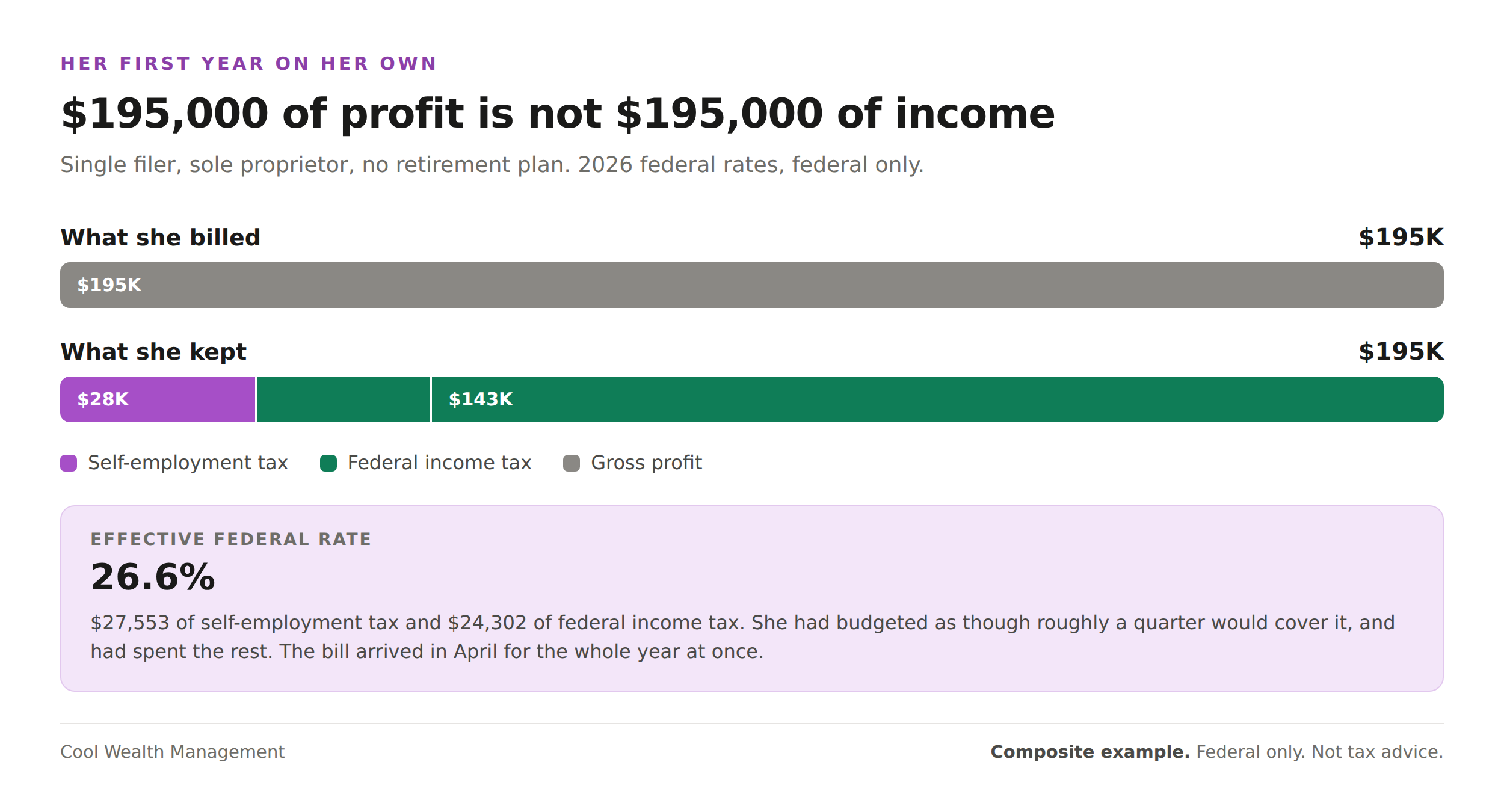
She'd been a salaried employee for eleven years. Then she went out on her own as an operations consultant, and the first year went better than she expected — $195,000 billed, most of it from three clients who'd known her at her old company.
She called us the following April, three days after her accountant sent her the return.
The number on it was $51,854.
She had about $9,000 in savings.
The thing nobody explains when you go out on your own
For eleven years, every paycheck she received had already had taxes removed. She never thought about it, because it was never her job to think about it. That's the entire value of a W-2, somebody else handles the timing.
The moment she started invoicing, three things changed at once, and nobody sat her down to explain any of them.
She became responsible for both halves of Social Security and Medicare. As an employee, her employer paid half (7.65%) and she paid the other half. Self-employed, she pays all 15.3%. On $195,000 of profit, that's $27,553 before a dollar of income tax.
Nobody was withholding anything. The IRS doesn't wait until April. It expects payment through the year, in quarterly installments, and charges an underpayment penalty when you don't.
Every dollar that hit her business account felt like income. This is the psychological trap, and it's the one that actually causes the damage. A $16,000 invoice lands and it looks like $16,000. About $4,300 of it was never hers.
Her effective federal rate came out at 26.6%. She had vaguely assumed "maybe a quarter" and had spent the rest, which is the most common version of this story.
What we did in the first month
There's no clever answer to a tax bill that's already due. There's only sequencing.
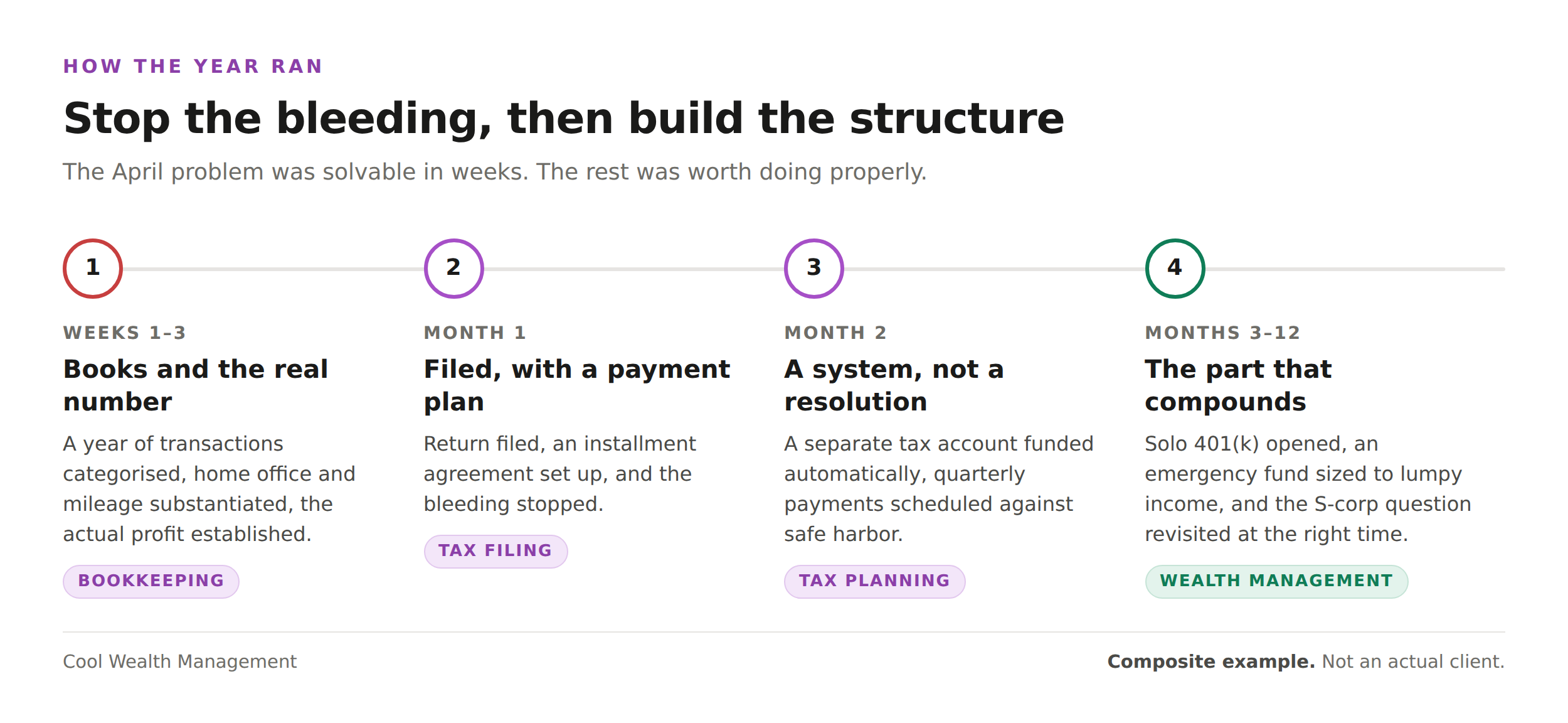
We filed properly, not quickly. The return her accountant prepared was accurate but thin. She'd taken almost no deductions, because she didn't know what qualified. Her home office had never been claimed. Neither had 9,000 miles of client driving, most of a laptop, her professional liability policy, or the conference she'd flown to in October. None of this is aggressive; it's just the ordinary cost of running a consulting business, and it hadn't been captured because nobody had asked her for it.
We set up an installment agreement. The IRS is considerably more reasonable than people expect if you file on time and communicate. The penalties for not filing are far worse than the penalties for not paying, and a payment plan stops the spiral.
We stopped it from happening again. This part took less than an hour and mattered more than everything else.
The fix was a bank account and a calendar
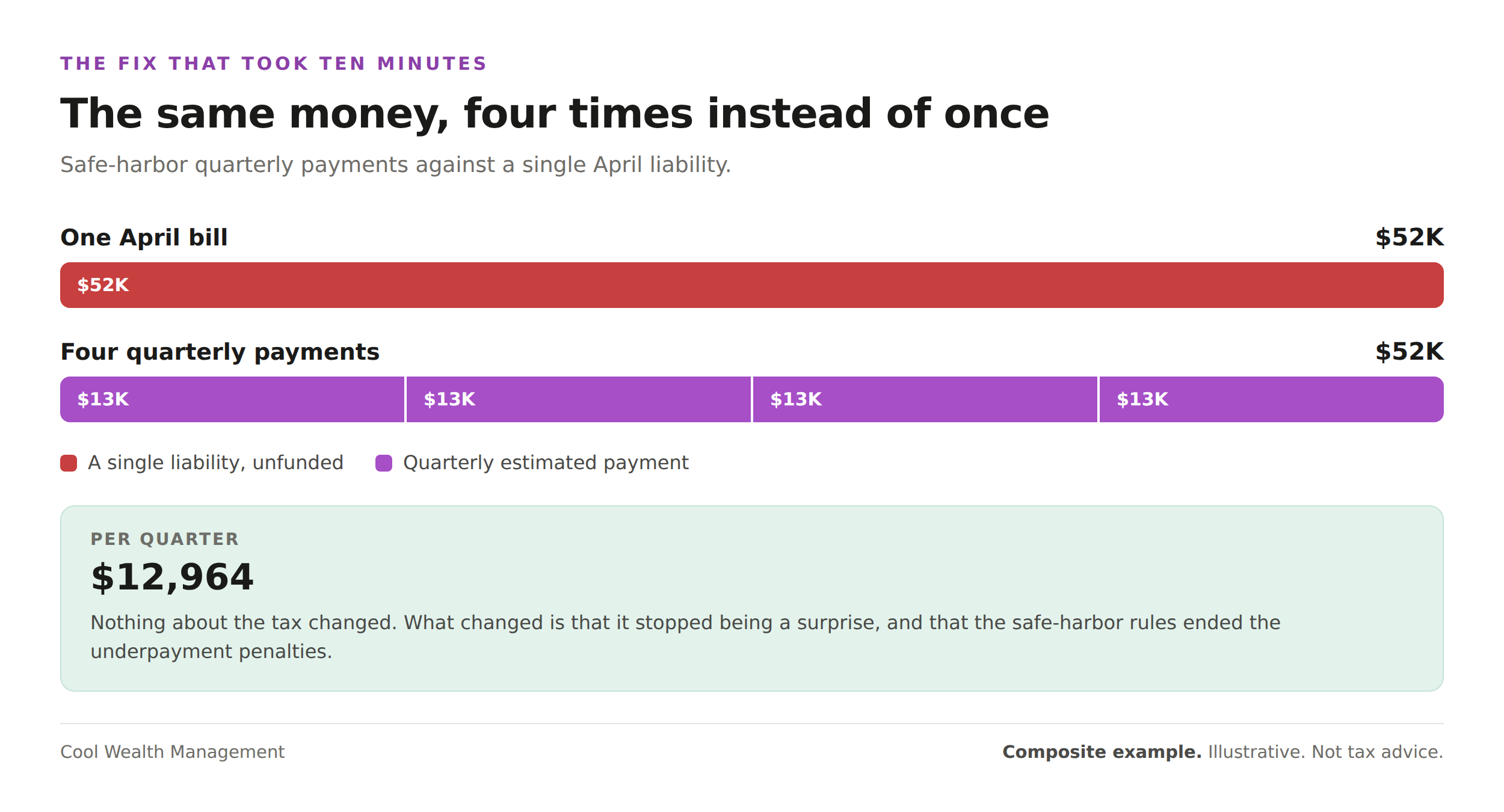
We opened a second business savings account. Every time a client payment lands, a fixed percentage moves into it automatically the same day. That account is not hers. It has one job.
Then we set quarterly estimated payments against the safe harbor. The safe-harbor rule is the useful part: if you pay in at least 100% of last year's tax, 110% at higher incomes, the IRS will not charge an underpayment penalty, no matter what this year turns out to be. It removes guessing from a year where income is unpredictable, which for a consultant it always is.
Same money. Four payments instead of one. The difference is that she now knows what's hers.
That's the whole front end of this engagement: a return filed properly, a payment plan, a transfer rule, and four dates in the calendar. It solved the problem she called about.
What we deliberately did not do yet
Everyone told her to form an S-corp. Her clients had mentioned it. Her brother-in-law had mentioned it.
At $195,000 of profit, an S-corp would save her roughly $5,600 a year after the payroll service and the extra return — real money, worth doing, but not the emergency. It also means running payroll, which is a monthly obligation, and she was already drowning in obligations. We agreed to do it at the start of the following tax year, when it wouldn't be one more thing she was failing to keep up with.
Sequencing matters more than optimization. An owner who is overwhelmed doesn't execute, and a strategy that doesn't get executed is worth nothing.
The part that was actually urgent
Here is what nobody was talking about, and what mattered more than the entity structure.
She had no retirement plan at all. Eleven years of 401(k) at her old employer, then nothing for a year. At her income, a solo 401(k) gives her room for $24,500 of her own deferral plus an employer contribution from the business, meaningfully more than the $7,500 an IRA allows. She'd gone from automatic contributions to none, and hadn't noticed because nobody sends you a reminder when you're your own employer.
Her income was three clients. One of them was 54% of her revenue. She'd left an employer to escape depending on one company's decisions, and had accidentally rebuilt the same exposure with fewer protections and no severance.
She had no disability coverage and no emergency fund. Her old job had both, and she'd never had to think about either.
This is the pattern with people who go out on their own after a long employed career. They replace the income. They don't replace the infrastructure that came with it, the retirement match, the group disability, the health coverage, the paid time off, the payroll department that handled the taxes. All of it silently disappeared, and the first sign was a $51,854 bill.
Where she is now
The tax debt is paid. The quarterly system runs without her thinking about it, which is the only kind of system that survives. She elected the S-corp the following January, which saves about $5,600 a year. There's a solo 401(k) with real money in it, an emergency fund at six months of household costs, and an own-occupation disability policy.
Her largest client is now 31% of revenue instead of 54%, which is the thing she's proudest of and the only item on the list that had nothing to do with tax.
If you're in your first year or two on your own
The question worth asking isn't "what do I owe." It's "what did my employer used to do for me that nobody is doing now."
The tax withholding is the obvious one, and it's the one that produces the April phone call. The retirement contributions, the disability coverage, the concentration risk of a small client list, those cost more over a career, and none of them send you a notice.
This is a composite example built from patterns we see across many engagements. It is not an actual client, and it is not a promise of similar results. Figures are illustrative, use 2026 federal rates, exclude state taxes, and are not tax advice. Cool Wealth Management is a registered investment adviser. Consult a qualified tax professional about your own situation.
