She Thought She Made 42% Margin. The Books Said 26%.
She sells home goods: ceramics, textiles, a few small furniture pieces mostly through one large marketplace with a Shopify store alongside it. Twenty-three products. About $1.4 million in revenue, growing steadily for four years.
She called about sales tax. She'd gotten a letter from a state she'd never set foot in, and she wanted to know whether it was legitimate.
It was. But it wasn't the expensive problem.
What we found in the first week
Her bookkeeping wasn't sloppy. Transactions were categorised, the bank was reconciled, the returns had been filed on time. By the standard most owners use, are the books clean? They were clean.
They were also wrong in a way that clean books can be wrong.
Her cost of goods sold contained only what she paid the factory. Everything else that it costs to get a ceramic bowl from a kiln overseas onto a customer's doorstep, ocean freight, duties, customs brokerage, the 3PL's receiving fees, storage, the cost of the units that come back damaged, was being expensed as it was paid, in whatever month it was paid.
That's a defensible way to run a chequebook. It's a terrible way to know what a product costs.
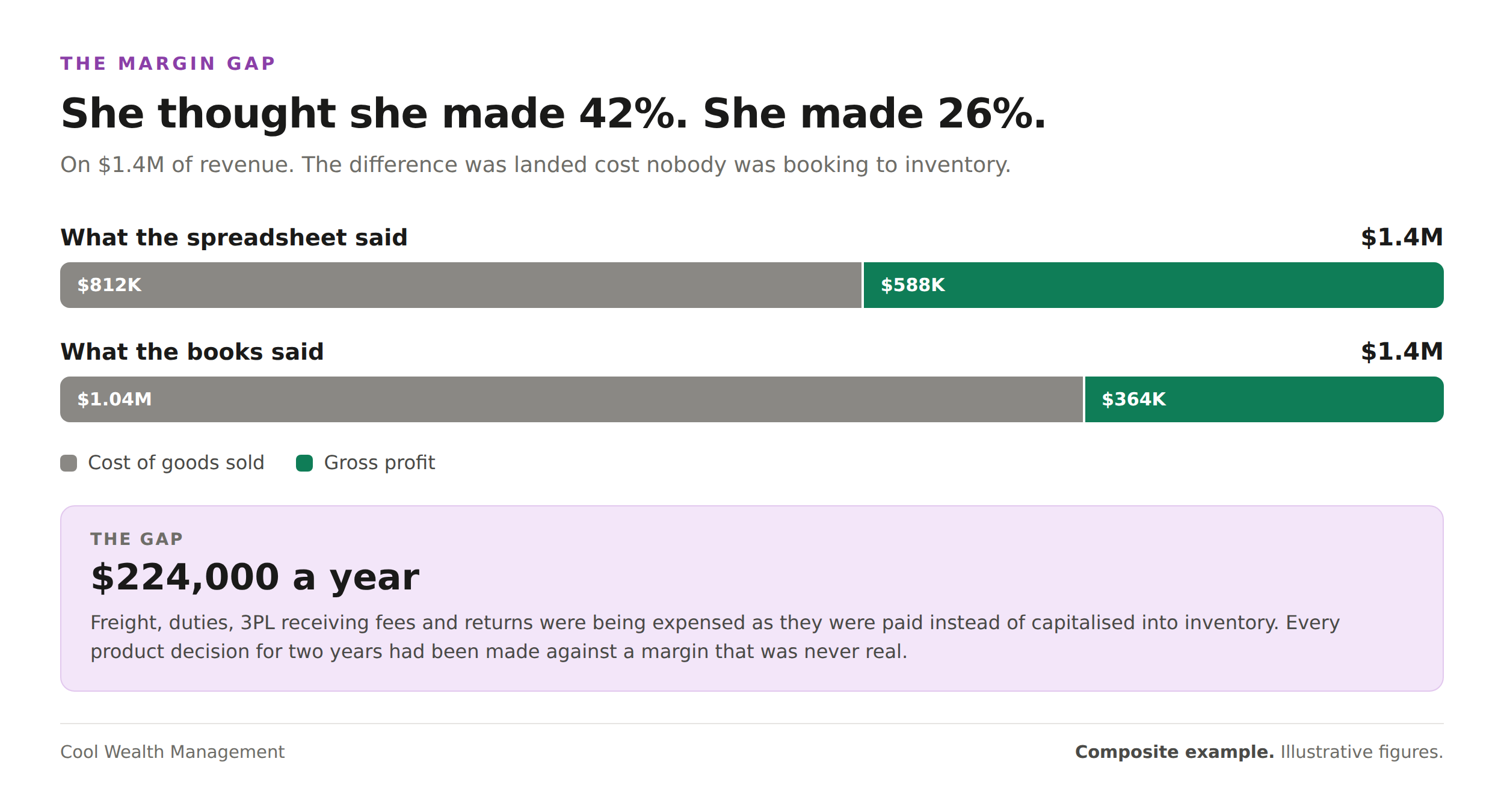
Her spreadsheet said 42% gross margin. The books, once we capitalised landed cost into inventory properly and matched it to units actually sold, said 26%.
Sixteen points. On $1.4 million, that's $224,000 a year that existed in the model and not in the bank.
Why this particular error is so common
It isn't carelessness. It's that e-commerce breaks the assumption underneath most small business bookkeeping.
In a service business, revenue and cost happen at roughly the same time. You do the work in March, you pay your people in March, and March's profit is approximately real.
In a product business, you pay for inventory in January, it sits on a boat in February, it lands in a warehouse in March, and you sell it across April, May and June. If you expense it in January, then January looks catastrophic and April looks fantastic, and neither is true. Add a container of freight that arrives in a different month than the goods it carried, and the distortion compounds.
Most bookkeeping is set up by someone applying service-business habits to a product business. It produces books that reconcile perfectly and describe nothing.
What the correct numbers changed
Three decisions followed within a month, and none of them were tax decisions.
Pricing. Four products had been priced off the 42% assumption and were, once loaded correctly, making about eleven points. She raised prices on all four. Two saw no measurable drop in volume, which told her something useful about her brand that she hadn't known.
The catalogue. This was the big one.
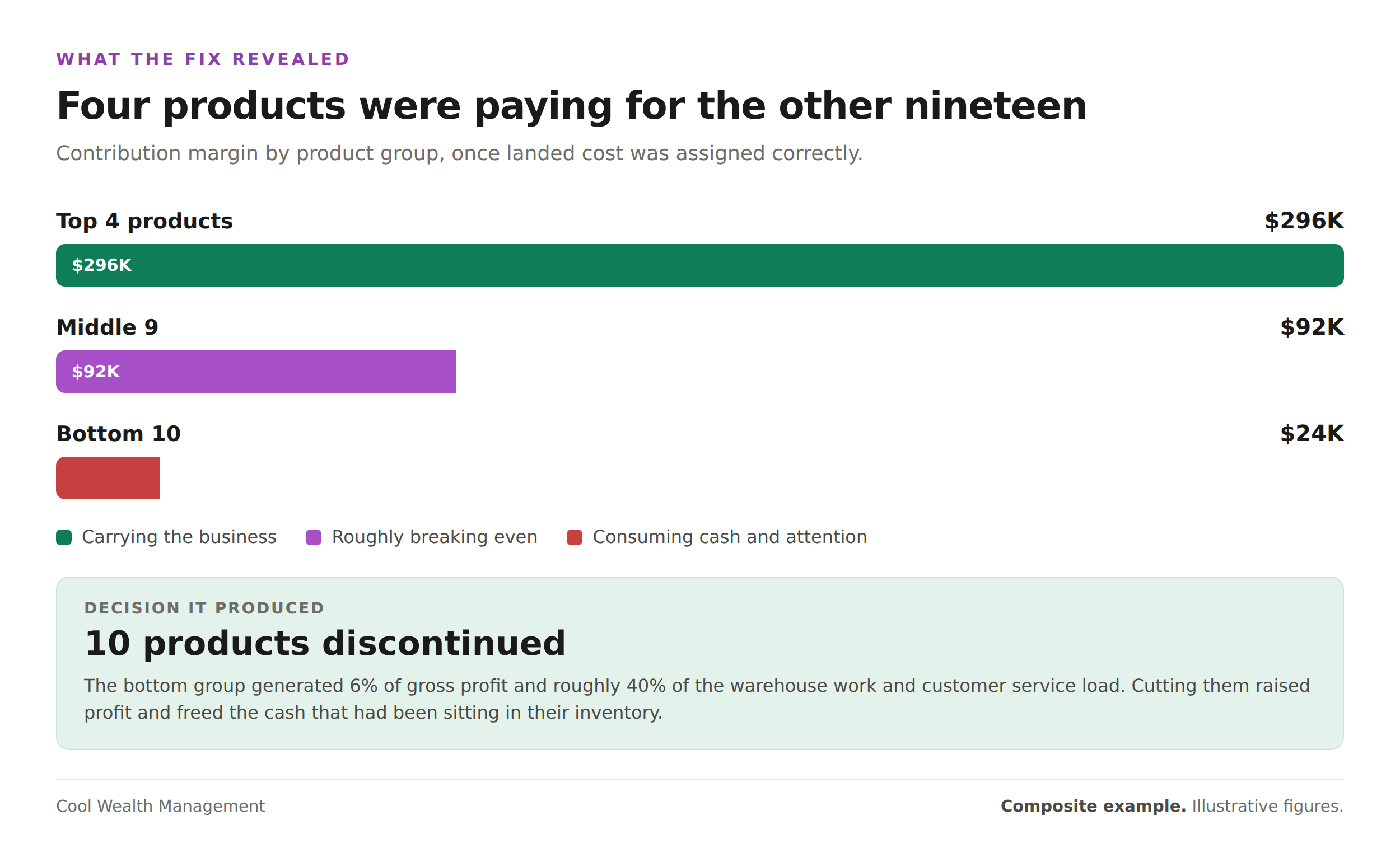
Once landed cost was assigned to individual products, the spread was extreme. Four products generated $296,000 of contribution. The bottom ten generated $24,000 combined, about 6% of gross profit, while consuming something closer to 40% of her warehouse handling, customer service tickets, and photography and listing maintenance.
She discontinued ten products. Profit went up. So did her Sundays.
Inventory purchasing. Her cash had been quietly migrating into slow-moving stock. The bottom ten products held roughly $180,000 of inventory that turned less than twice a year. Selling through it and not reordering released cash she'd been about to borrow against.
And the sales tax letter
Real, and she owed. Economic nexus rules mean you can create a filing obligation in a state purely by selling into it, with no office, no employee, and no idea it happened.
We reviewed all fifty states against her sales data, found registration obligations in eleven, registered her, and quantified the back exposure. Most states have a voluntary disclosure process that limits how far back they'll look and typically waives penalties if you come to them before they come to you. She'd already gotten one letter, which closed that option in that state but not in the other ten.
That work is unglamorous, and it removed a liability that would have surfaced at the worst possible moment, which for an e-commerce business is during diligence when someone is buying you.
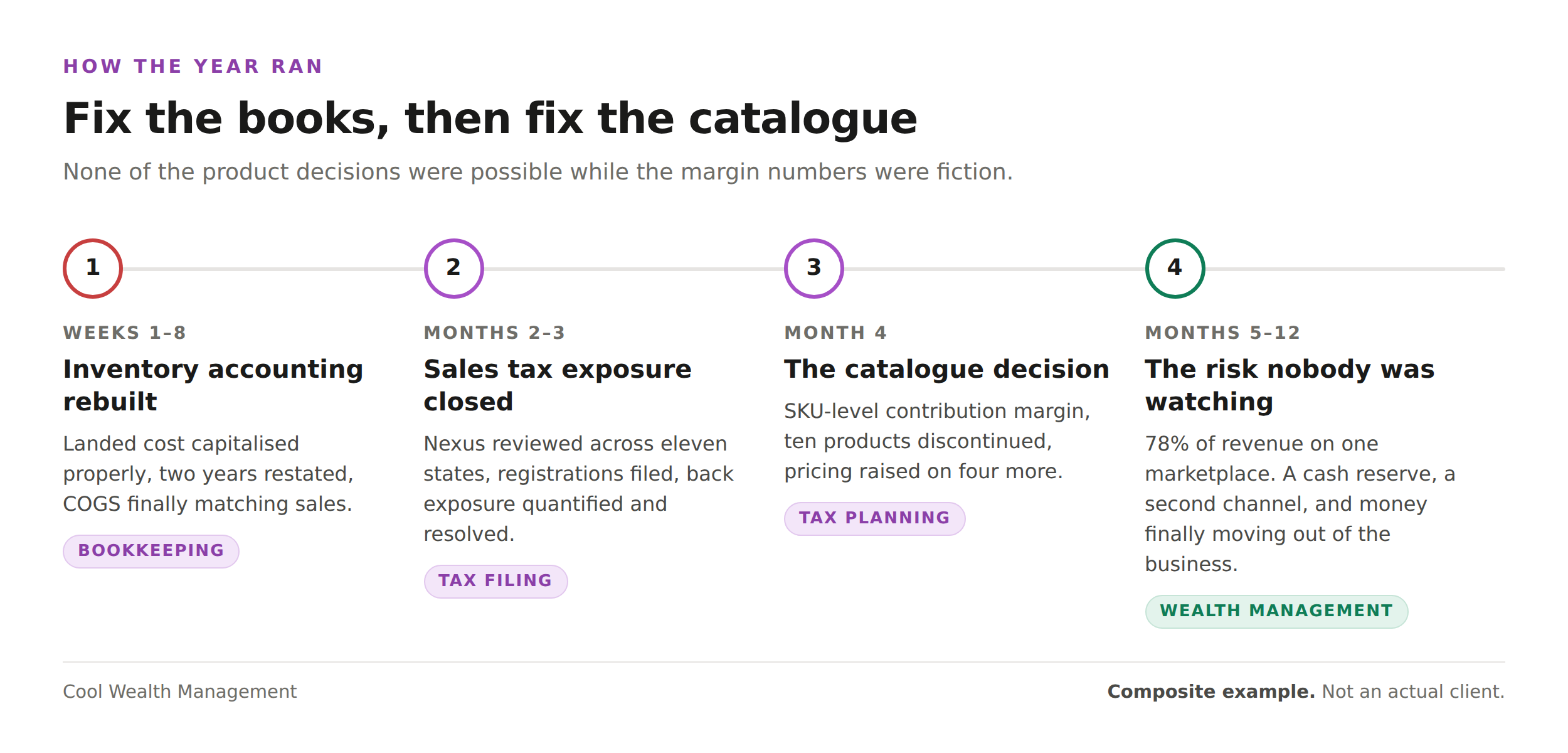
The conversation the clean books finally allowed
Here's what became visible once the numbers were true, and what we'd have had no standing to raise before.
78% of her revenue came from one marketplace. Not one customer: one platform, which sets the fees, controls the search ranking, owns the customer relationship, and can suspend an account with an automated email. She'd built a genuinely good business on top of someone else's, and she'd never priced that risk because it had never cost her anything yet.
We didn't tell her to abandon it. That would be silly; it's where the customers are. We built the second channel deliberately over eighteen months — her own store, an email list she owns, and two wholesale accounts, with the goal of getting the marketplace below 60%. Not because the marketplace is bad, but because a business with one point of failure is worth less and sleeps worse.
Everything she'd ever earned was still in the business. Four profitable years, and her personal balance sheet was a checking account and an old 401(k) from a job she'd left in 2019. Every dollar of profit had gone back into inventory. That's normal in a growing product business and it's also how owners reach forty with a good company and no money.
We started moving profit out on a schedule, a solo 401(k), then a taxable account, treating it as a fixed cost rather than whatever was left over. The first year was uncomfortable. It's supposed to be.
She'd never had the business valued. She assumed it was worth "a couple million" because revenue was $1.4 million. Product businesses at her size trade on earnings, not revenue, and her earnings were considerably lower than she believed until the pricing and catalogue changes took hold. The work that raised her margin also raised what the business is worth, by more than the margin improvement itself because buyers pay a multiple of it.
Where she ended up
Margin at 34% and climbing, against a real 26% baseline rather than an imaginary 42%. Ten products gone, four repriced, $180,000 of cash released from dead inventory. Registered and current in eleven states. A marketplace concentration heading down instead of up. Money leaving the business every month for the first time since she started it.
She called about a letter from a state tax authority. The letter cost her a few thousand dollars to resolve. The bookkeeping underneath it was costing her a great deal more, quietly, every month, and it had been doing so for two years while the books looked perfectly clean.
If you sell physical products
The question to ask your bookkeeper is simple: is landed cost capitalised into inventory, or expensed when paid?
If it's expensed when paid, your margins aren't real, your monthly profit is noise, and every pricing decision you've made is built on a number that doesn't exist. It's the single most common, and most expensive, error in e-commerce bookkeeping, and it hides inside books that reconcile perfectly.
This is a composite example built from patterns we see across many engagements. It is not an actual client, and it is not a promise of similar results. Figures are illustrative and not tax advice. Sales tax obligations vary by state and by facts. Cool Wealth Management is a registered investment adviser. Consult a qualified tax professional about your own situation.
